Brunnenbau, building in Bavaria, Germany
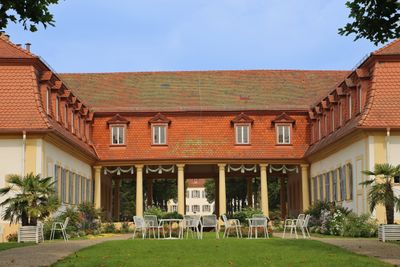
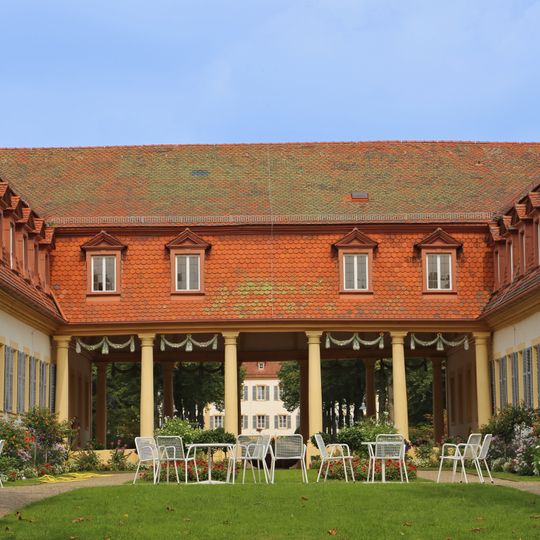
Brunnenbau is a two-winged, single-storey early Neoclassical spa building erected in 1787 in Bad Bocklet. Two north–south wings with mansard hipped roofs — a bathhouse on the east and a hall for dance and conversation on the west — are joined at their northern entrance front by an open peristyle of two rows of six Tuscan columns. The central temple, about 15.25 by 12.80 metres, bears the gilded inscription "Für das Beste der leidenden Menschheit erbauet im Jahre 1787".
The Bocklet spring was discovered around 1720 by pastor Johann-Georg Schöppner and later named Stahlquelle for its iron content. Prince-Bishop Franz Ludwig von Erthal commissioned architect Johann Philipp Geigel to build the Brunnenbau, completed in 1787 over the spring. It is listed as monument D-6-72-112-5.
The golden inscription on the front of the central columned hall reads "Für das Beste der leidenden Menschheit erbauet im Jahre 1787" (built for the good of suffering humanity in 1787). The spring itself was renamed Balthasar-Neumann-Quelle in the 1960s, recalling the architect who first had it captured.
The Brunnenbau stands at the southern end of the spa garden, roughly 600 paces from the Fürstenbau on the northern side. Its ground-floor reading room in the western hall holds current newspapers and magazines and hosts occasional chamber and piano concerts; the other rooms are hotel rooms, so visitors should keep to the public areas.
The golden inscription on the front of the central columned hall reads "Für das Beste der leidenden Menschheit erbauet im Jahre 1787" (built for the good of suffering humanity in 1787). The hall is about 15.25 by 12.80 metres, and its roof rests on two rows of six Tuscan columns.
The community of curious travelers
AroundUs brings together thousands of curated places, local tips, and hidden gems, enriched daily by 93,519 contributors worldwide.