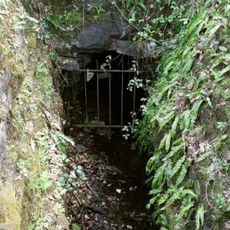
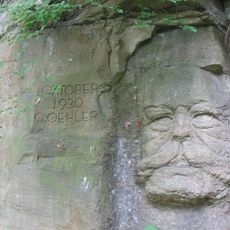
St.-Johannes-Erbstollen, Mining adit in Witten, Germany
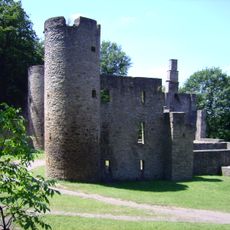
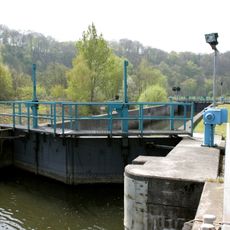
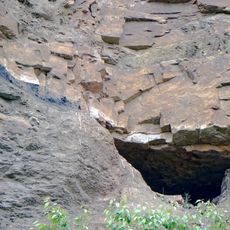
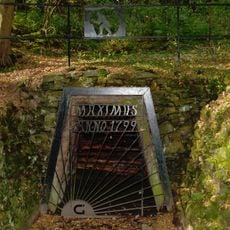
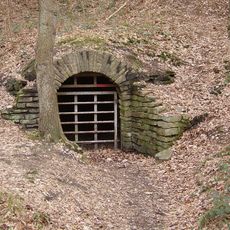
St.-Johannes-Erbstollen is an adit driven from 1777 southward from a mouth near the Ruhr, west of Hardenstein castle ruin, at +77 m above sea level. Its level runs about two metres high through hard rock, partly blasted, in the Deipenbecke valley west of the Muttental. Self-closing doors at the mouth were meant to keep out Ruhr floods.
The first adit at Hardenstein was driven in 1767 under Johann Peter Mahler but abandoned the next year. In 1777 the landowner Johann Henrich Oberste Frielinghaus and several collieries, including Frielinghaus, Stralsund and Kurze Eggersbank, had a new deep adit driven; its mouth lay on the Ruhr west of Hardenstein Castle at +77 m above sea level, seven metres below the Bommerbänker Erbstollen. The mining official Freiherr vom Stein inspected it in 1784, when it had reached 40 metres, and again in 1786 at 75 metres.
The name St. Johannes refers to John the Baptist, a common patron for mining adits in the 18th-century Märkischer district. The adit was driven with hammer and chisel and partly with explosives through hard rock, leaving tool marks on the walls. It served as the region's main adit for draining and ventilating the surrounding coal mines.
The adit is not open to visitors; the mouth lies by the Ruhr west of Hardenstein castle ruin, at +77 m above sea level, seven metres lower than the Bommerbänker Erbstollen. Its self-closing doors were fitted to keep Ruhr floodwater out, and in wet seasons they repeatedly halted driving. View the portal from outside only.
The adit mouth was fitted with self-closing doors to keep Ruhr floodwater out. In rainy seasons these doors caused problems and work often had to be suspended. The mouth lies at +77 m above sea level, seven metres deeper than the Bommerbänker Erbstollen and twelve metres below the Frielinghaus adit.
The community of curious travelers
AroundUs brings together thousands of curated places, local tips, and hidden gems, enriched daily by 94,049 contributors worldwide.