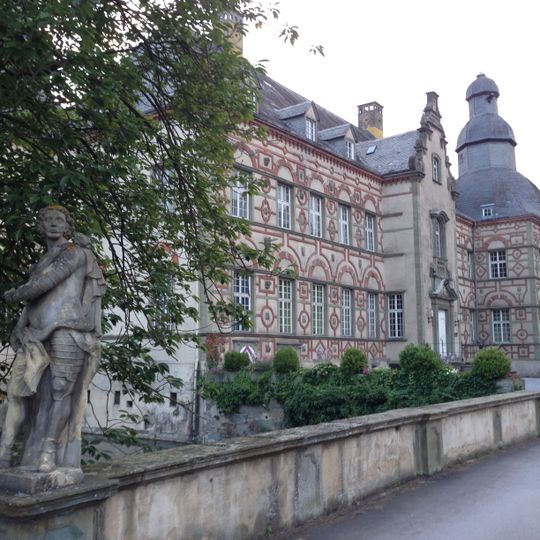
Schloss Overhagen, Renaissance castle in Lippstadt, Germany.
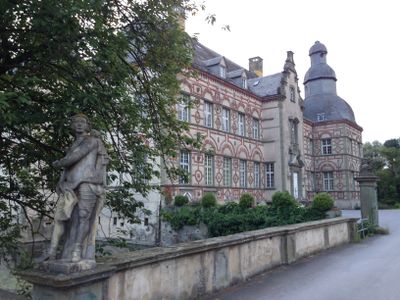
Schloss Overhagen is a long, two-storey Renaissance building from 1619, set on two islands and surrounded on three sides by moats. Two corner pavilion towers with tall, stepped Baroque cupolas stand diagonally offset from the main block. The park-side facade is plastered with red bands forming geometric patterns, interspersed with diamond-shaped rustication and carved stones showing animal heads, human portraits and grimacing faces.
A first mention of the site dates from 1203, when the lords of Overhagen held it; the property passed to the von Schorlemer family in the same century. In 1619 the old building was demolished and replaced by a new one in the Lipperenaissance style, designed by Laurenz von Brachum the Younger. The family lived there until 1945 and leased the complex to a school association in 1962.
The site functions as a school where students and teachers work within rooms originally designed for nobility, creating a living connection between education and historical spaces. This everyday use keeps the building active and integrated into community life.
The castle stands in the Overhagen district of Lippstadt, not the city centre. Since 1962 it has been leased to a school association and houses a private gymnasium, so interiors are not open to visitors. The moated exterior and the park-side facade can be viewed from the surrounding paths.
The walls feature an unusual three-dimensional decoration created by carved stone ornaments that protrude from the surface, depicting various living and abstract forms. This sculptural approach to wall ornamentation is a rare example of hands-on decorative craftsmanship from the Renaissance period.
The community of curious travelers
AroundUs brings together thousands of curated places, local tips, and hidden gems, enriched daily by 94,042 contributors worldwide.