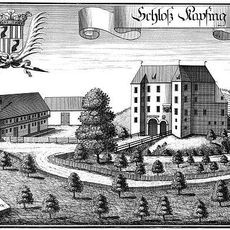
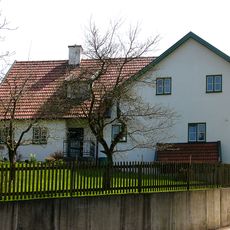
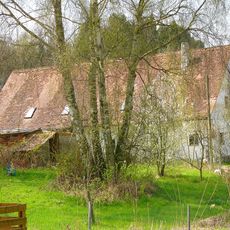
Schloss Ast, dreigeschossiges Gebäude mit Halbwalmdach, an der Nordseite zwei polygonale Ecktürme mit Zwiebelhaube, mit Putzgliederung, im Kern 1591, wesentlich umgebaut zweiten Hälfte 17. Jahrhundert, erneuert Mitte 19. Jahrhundert; mit Ausstattung;
Schloss Ast is a manor house in the municipality of Tiefenbach in Bavaria that dates from multiple building phases spanning the Renaissance to the 19th century. The three-story structure with a half-domed roof features two small onion-domed towers on its north side and is defined by a whitewashed facade with characteristic stripes.
The building was constructed in 1591 by Ambrosius Plank and suffered damage from Swedish troops during the Thirty Years War (1618-1648) but was restored in the following years. In the mid-1800s, the castle underwent significant renovations that resulted in the form visible today.
The castle shapes the appearance of the small village of Ast and connects different centuries through its visible layers. The whitewashed walls with their characteristic stripes and the two onion domes on the north side show how people built and modified here over time.
The castle is privately owned and cannot be visited from the inside, but the exterior is accessible from the road. The grounds sit quietly on a gentle rise in the rural countryside and are best explored during daylight hours.
The west side of the castle once bore a watchtower that was demolished around 1930 and now lives on only in local stories. This vanished structure reveals how the building's outline changed in the 20th century.
The community of curious travelers
AroundUs brings together thousands of curated places, local tips, and hidden gems, enriched daily by 92,579 contributors worldwide.