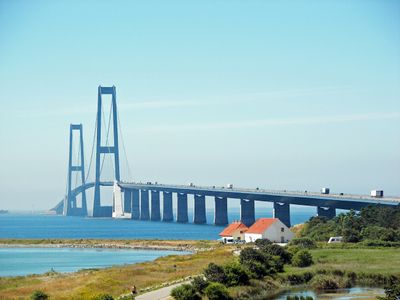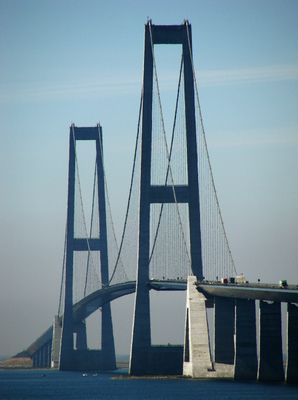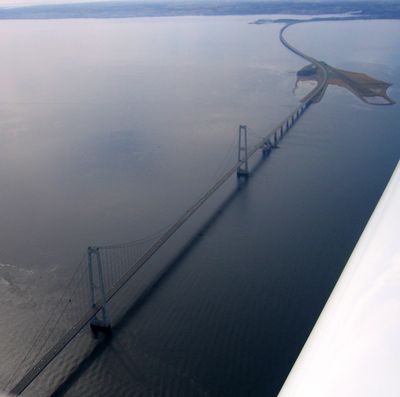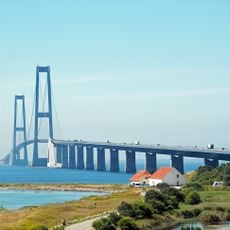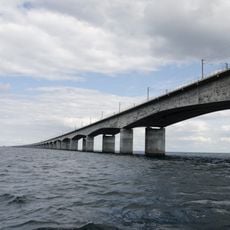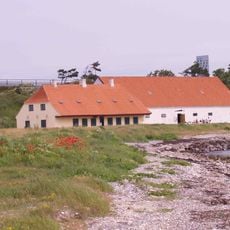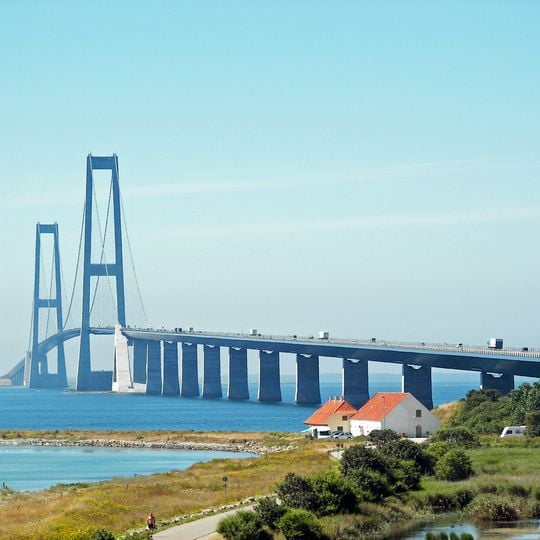
Great Belt Fixed Link, Road and rail fixed link between Zealand and Funen, Denmark.
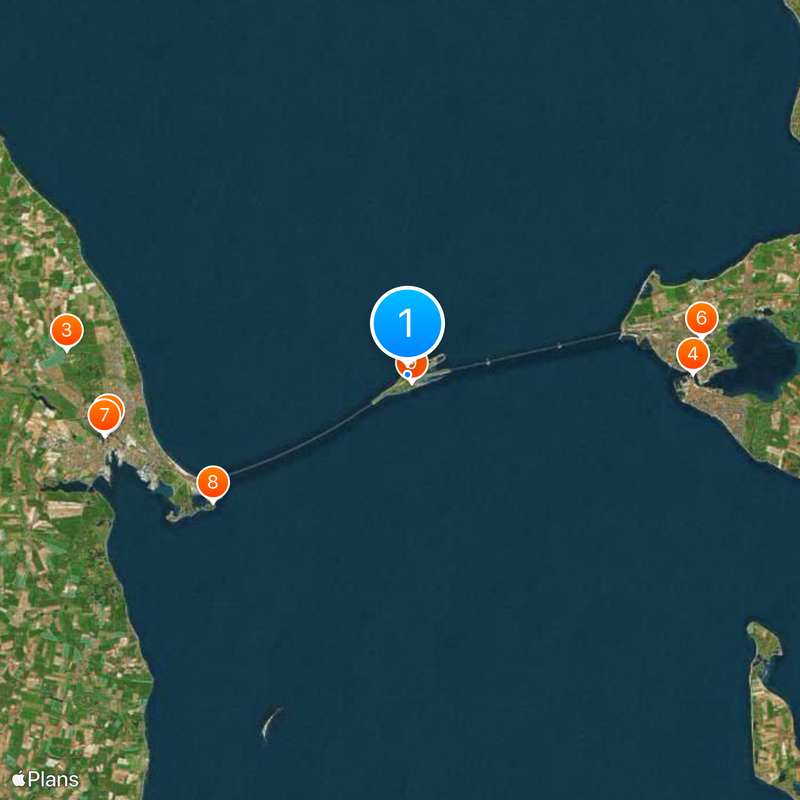
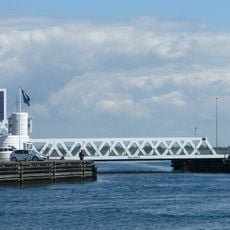
The system spans 18 kilometers across the Great Belt and consists of two separate structures: a rail link via Sprogø island with tunnel section and a highway bridge farther north. The East Bridge crosses the main navigation channel with a suspension bridge construction measuring 1,624 meters in length, while the West Bridge extends 6,611 meters as a lower box-girder bridge over waters west of Sprogø. Both structures carry traffic on separate alignments between Halsskov on Zealand and Knudshoved on Funen.
Planning for a Belt crossing began in the 1930s, but the Danish Parliament only approved construction in 1986 after decades of debate over technical feasibility and financing. Work started in 1988 under the state-owned company A/S Storebælt, with the railway tunnel opening in 1997 and the highway bridge in 1998. The project cost the equivalent of 4.4 billion euros and was considered the largest infrastructure undertaking in Scandinavian history at completion.
The fixed link created a continuous land route between Copenhagen and Jutland, ending Zealand's centuries-old transportation isolation. Elimination of the ferry service fundamentally altered the economic structures of both islands and enabled new commuter patterns between regional labor markets. Today over 27,000 vehicles use this crossing daily, directly connecting mainland Denmark with the capital region for the first time and physically manifesting national cohesion.
The toll costs 245 Danish kroner for passenger cars and can be paid electronically or at payment stations, with subscriptions offering discounts for frequent users. The crossing takes approximately 15 minutes between toll stations on either side. Pedestrians and cyclists are not permitted on the bridges but can book a bus transfer service. Service areas with restrooms and refreshments are located at both ends of the route, not on the bridges themselves.
The 8-kilometer rail tunnel beneath the eastern Belt sits 75 meters below sea level and was Europe's deepest underwater tunnel at opening. During construction, engineers unexpectedly encountered large amounts of clay instead of the anticipated sandy seabed, forcing changes to the tunneling method. The tunnel sections were prefabricated in a dry dock facility at Nyborg, positioned on the seafloor and connected together.
The community of curious travelers
AroundUs brings together thousands of curated places, local tips, and hidden gems, enriched daily by 60,000 contributors worldwide.