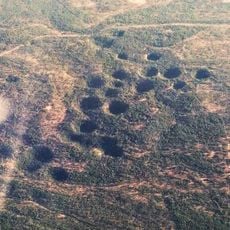
Villalba de la Sierra Formation, Geological formation in Cuenca Province, Spain
The Villalba de la Sierra Formation is a geological rock layer in Cuenca Province made of grey mudstone and sandstone from the Late Cretaceous. These layers built up over time in wide, flat areas that flooded regularly.
The formation developed between about 84 and 66 million years ago during the Late Cretaceous period. Climate shifts during this time changed water flow patterns and how sediments settled in the landscape.
Scientists study this formation to understand the evolution of species through extensive collections of fossils, including dinosaur eggs and titanosaur remains.
Access to this formation is possible through several excavation sites located throughout the region. The most productive locations for studying fossils are at designated research areas where ongoing work takes place.
This site emerged as one of Europe's most important locations for dinosaur eggs and has drawn researchers from around the world. The Lo Hueco excavation site has led to the discovery of rare titanosaur specimens found nowhere else.
The community of curious travelers
AroundUs brings together thousands of curated places, local tips, and hidden gems, enriched daily by 91,590 contributors worldwide.