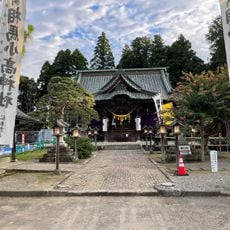
Hiwashi-jinja, Shinto shrine in Japan
Hiwashi-jinja is a Shinto shrine in the Odaka district of Minamisoma, Fukushima Prefecture. Its one-bay nagare-zukuri honden, rebuilt in 1847 and re-roofed in copper in 1989, stands behind a worship hall and offering hall. A prayer hall with a folding hexagonal goma altar sits beside the approach, and the stone steps were built in 1829 by priest Nishiyama Masatomo.
Originally called Ōgata Shrine in Shimōsa Province, it was moved to its present site in 1364 by Sōma Shigetane, who brought the deity from Shimōsa in 1323. The shrine was renamed Hiwashi-jinja in 1872 after the Meiji government restricted the use of "miya" to imperial ancestors. It was listed as a village shrine (sonsha) under the old shrine ranking system.
The shrine's torinoko market rite, held on the first Day of the Rooster in November, gave out small kumade rakes from the shrine to rake in wealth and goods; the custom survives among merchants. Early taro heads were also sold then, a pun on taking an enemy's head in war.
The shrine stands in the Omagari women's field area of Odaka district, reached by stone steps whose first and third flights date from 1829 and were built by the priest Nishiyama Masatomo. The Nishiyama family still serves as priests here. The prayer hall beside the approach has a folding goma altar once carried to outside ceremonies; it is now fixed so it cannot be split.
Beside the stone stele of the Dōsojin guardian deity stands the Hoto-ishi, a stone shaped like female genitalia, venerated for descendants and marital harmony. The shrine also keeps a folding goma altar once carried to off-site rites, and its stone steps were built single-handedly by priest Nishiyama Masatomo in 1829.
The community of curious travelers
AroundUs brings together thousands of curated places, local tips, and hidden gems, enriched daily by 95,354 contributors worldwide.