Tatetsuki Site, Yayoi period burial mound in Kurashiki, Japan
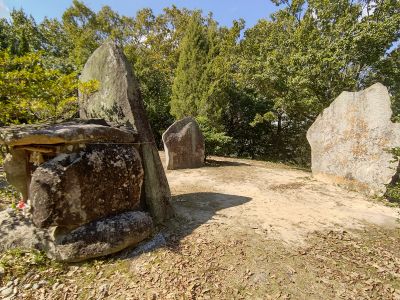
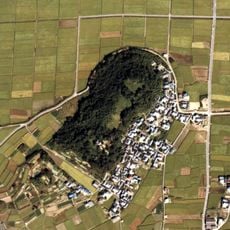
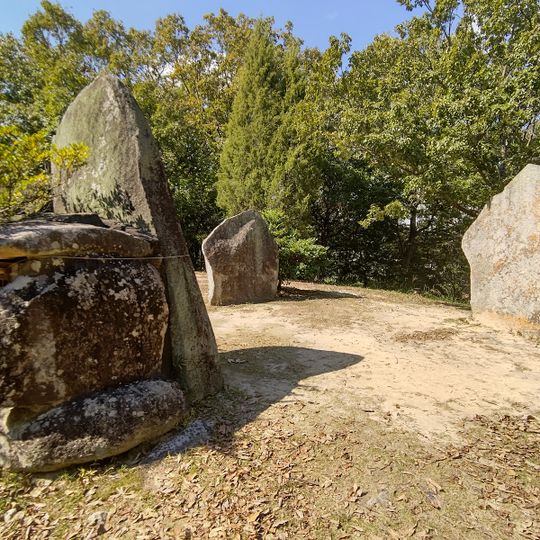
Tatetsuki Site is a late Yayoi period keyhole-shaped burial mound in Yabe, Kurashiki, Okayama Prefecture. Its irregular circular main mound, about 49 meters across and 4 to 5 meters high, has rectangular projections to the northeast and southwest, giving an estimated total length of 83 meters. The mound was formed by cutting the natural hill and adding earth, with two rows of standing stones on the slope and six upright stones on the summit.
Built in the late 2nd century, the mound held a wooden coffin about 2 m long whose base was covered with 30 kg of cinnabar. The coffin lay inside a 3.5 m wooden outer box with an iron sword, two necklaces and glass beads. The site became a national historic site in 1981.
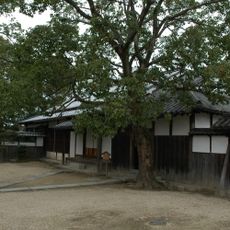
The mound's name comes from the standing stones on top, which were likened to a shield (tate). A shrine, Tatetsuki Jinja, stood here from the 1680s until the early 20th century; its sacred object, a stone carved with arc-band patterns, is now kept in a nearby storage house and is a nationally designated Important Cultural Property.
The site is openly accessible and can be visited without special preparation, as it sits within a residential area of Kurashiki. Comfortable walking shoes are recommended since you'll want time to circle the mounds and observe their shape from different angles.
The central wooden coffin, about 2 m long and 0.7 m wide, lay inside a 3.5 m by 1.5 m wooden outer box and held 30 kg of cinnabar on its floor. Only two tiny tooth fragments survived; an iron sword, two necklaces and many glass and tube beads were found in the outer box. A second burial 9 m southeast held just traces of cinnabar.
The community of curious travelers
AroundUs brings together thousands of curated places, local tips, and hidden gems, enriched daily by 94,532 contributors worldwide.