Kaijin Shrine, Shinto shrine in Nagasaki Prefecture, Japan
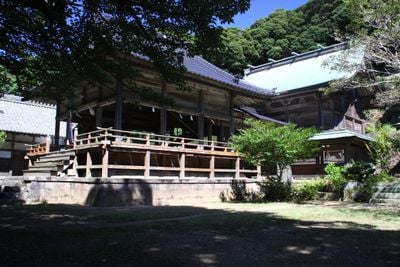
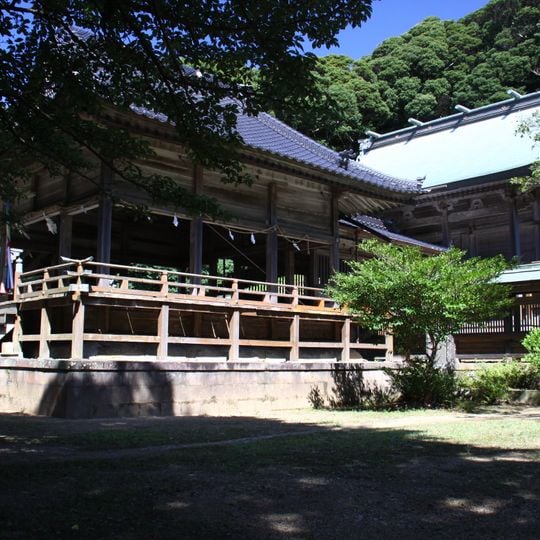
Kaijin Shrine stands on Izu-yama in the Kibisaka area of Tsushima. Its wooden hall, built in 1921, rests on a stone retaining wall; a railed veranda supported by square posts wraps the front and left side, and white paper ornaments hang from the eaves of the broad, gently sloping dark grey roof. The honden is a nagare-zukuri building of 24 tsubo, about 14.55 m wide and 10.91 m deep, originally roofed in cypress bark and later retiled.
According to shrine tradition, Empress Jingū enshrined eight banners here after her return from the Korean campaign, and the shrine later became the head Hachiman shrine of the upper district. In 1870 it was renamed Watatsumi Shrine, and in 1871 it was listed as a Kokuhei Chūsha and renamed Kaijin Shrine, with Toyotama-hime replacing Hachiman as the main deity. The present sanctuary building dates from 1921.
The name Watatsumi means sea deity, read Kaijin to avoid confusion with another Watatsumi Shrine. Until the Edo period the shrine honoured Hachiman; in 1872 the deity was changed to Toyotama-hime. The June rite includes the myōbu no mai, a miko dance with bells and drums, and a hōjō-e in which sea snails are released, recalling the pacification of Silla.
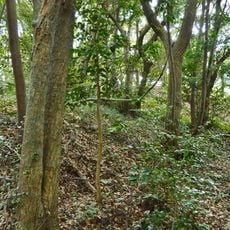
Kaijin Shrine stands at 247 Kizaka, Mine-cho, Tsushima, on the slope of Mount Izu, above the village of Kizaka. The precinct covers roughly 67,828 square metres, with forested hillside behind the buildings. The approach is uphill and unpaved in places, and the shrine is reached by road from the Kizaka area; the surrounding settlement lies south of the shrine, across the river.
The shrine holds the status of ichinomiya, meaning it is the highest-ranked Shinto shrine in its region. This designation gives it special standing among the sacred places on the island.
The community of curious travelers
AroundUs brings together thousands of curated places, local tips, and hidden gems, enriched daily by 93,382 contributors worldwide.