Wisteria in Ushijima, Special Natural Monument in Kasukabe, Japan
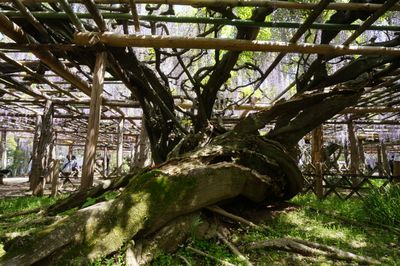
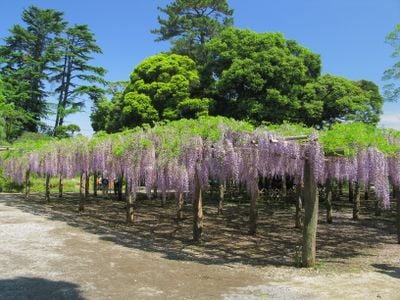
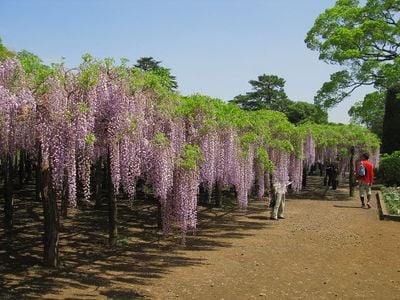
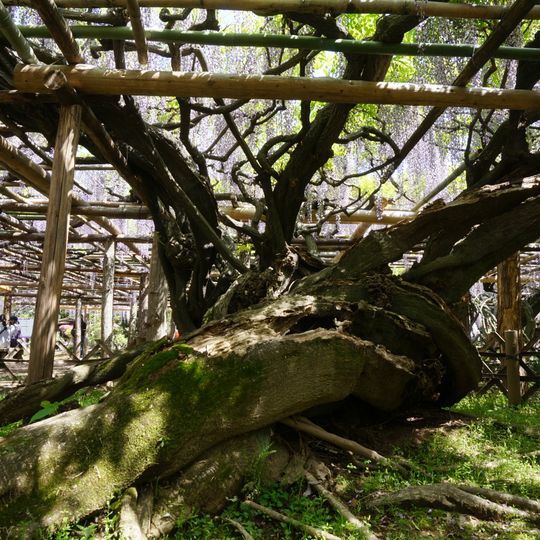
Wisteria in Ushijima is a giant Nodanaga wisteria in Kasukabe, Saitama Prefecture, with a trunk circumference of 9.2 m and a trellis spanning about 34 m east-west and 14 m north-south. Its pale purple racemes, up to 2 m long, hang from a wooden framework supported by posts and horizontal beams.
The wisteria stands on the former grounds of Renge-in, a Shingon temple that was abolished in 1874. Tradition holds that Kobo Daishi (Kukai) planted it himself, and its age is given as 1,000 to 1,200 years. It was designated a national Natural Monument on 18 January 1928 and upgraded to Special Natural Monument on 22 August 1955; it is the only wisteria so designated.
The wisteria is the original tree of the cultivar Noda-naga-fuji, also called Murasaki-naga-fuji, and its flower clusters are so long that it is known as Kujaku-fuji, the nine-shaku wisteria. According to tradition, it was planted by the monk Kobo Daishi (Kukai). The site was once the grounds of the Shingon temple Renge-in, which was abolished in 1874; it is now managed by the Kojima family's Yugen Kaisha Fuji-en.
The garden lies about 10 minutes on foot from Tobu Noda Line's Fujino-ushijima Station, or roughly 15 km (20 minutes) from the Iwatsuki Interchange of the Tohoku Expressway and 20 km (30 minutes) from the Kashiwa Interchange of the Joban Expressway. The wisteria flowers from late April to early May, when the racemes can reach 2 metres.
The trunk has a circumference of around 9 meters, which is striking even by the standards of old trees. The plant is estimated to be over 1,200 years old, placing it among the oldest known wisteria plants in the world.
The community of curious travelers
AroundUs brings together thousands of curated places, local tips, and hidden gems, enriched daily by 94,272 contributors worldwide.