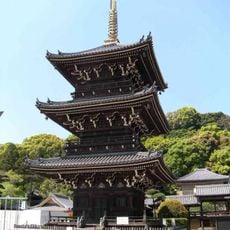
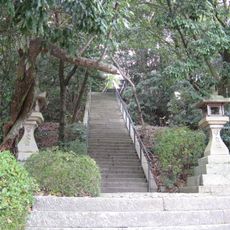
Sekikawa Shrine, Shinto shrine in Japan
Sekikawa Shrine (Tsugawa Jinja) in Kishiwada is a Shinto shrine whose honden, rebuilt in 1603 under Toyotomi Hideyori with Katagiri Katsumoto as magistrate, is a three-bay nagare-zukuri structure with a chidori-hafu gable and cypress-bark roof, designated an Important Cultural Property in 1914. Its grounds hold a pair of stone lanterns said to have been donated by the Osaka merchant Kagaya Shirozaemon, and a muku tree listed as a natural monument by the city.
Founded, by tradition, under Emperor Sujin and recorded in the 927 Engishiki register, the shrine was ranked junior fourth rank in 864 and senior fourth rank in 873. In 1181 it was donated to the Kumano Shrine estates, and in 1165 it paid tribute of Kishu combs to the Jingikan. Toyotomi Hideyori had the main hall repaired in 1603, and it became a village shrine in 1873.
The shrine's name is written with the characters for "accumulated river", and a tradition links the place name "Nukazuku" (額) to Emperor Shirakawa, who is said to have written a plaque here in 1090. The shrine keeps a wooden image group of male and female deities from the Kamakura period and a portable mikoshi said to have been donated by Yodo-dono. Its annual festival falls on 8 October.
Sekikawa Shrine stands in the Tsumikawa district of Kishiwada, reached by road rather than by train. A separate worship site (yōhaisho) lies on the Kumano Kodo (Prefectural Route 30) in Komatsuri-chō, at the point where distant parishioners once stopped to pray toward the shrine. The main festival is held on 8 October.
The shrine keeps a set of four wooden male and female deity statues from the Kamakura period, designated an Osaka Prefecture tangible cultural property. A sacred palanquin, said to have been donated by Yodo-dono, is also held here and has been submitted for cultural property status.
The community of curious travelers
AroundUs brings together thousands of curated places, local tips, and hidden gems, enriched daily by 93,480 contributors worldwide.