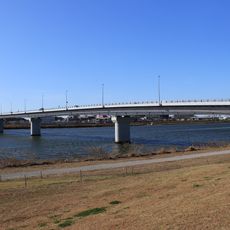
行徳可動堰, Water control weir in Ichikawa, Japan.
Gyotoku Movable Weir controls water flow where the Edo River meets the Edogawa Floodway in Ichikawa. The structure uses cylindrical gates that can be raised with cable mechanisms to manage water movement and block saltwater intrusion.
A fixed weir built at the mouth of the Edogawa Floodway in 1919 was the predecessor of today's structure. Because it could not handle the increased flow of typhoons such as Kathleen in 1947, construction of a movable weir began in 1950 and was completed in March 1957. It was originally built together with the Gyotoku Bridge as a single structure.
The weir's name comes from the former Gyotoku town on the Edo River's left bank. Together with the Edo River Water Gate, it keeps water levels high enough for intake during droughts, securing irrigation and industrial water for Tokyo and Chiba and tap water for about 7.6 million people.
The weir is visible from the outside and visitors can observe the large gates and the river facility area. It is best to visit during normal water conditions when the site is safe to explore and the mechanism is easier to understand.
The weir's design was revised in 2009 to protect the habitat of the endangered Hina-ito-tombo damselfly and the tidal flats around it, so the existing structure was partly rebuilt instead of replaced by a new weir 170 m upstream.
The community of curious travelers
AroundUs brings together thousands of curated places, local tips, and hidden gems, enriched daily by 93,782 contributors worldwide.