Nagatoro Valley, Natural monument and canyon in Nagatoro, Japan
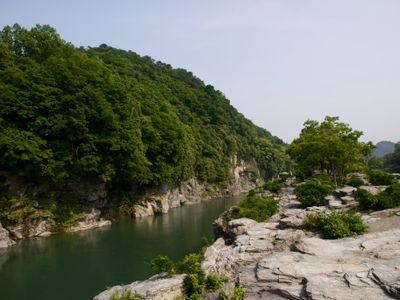
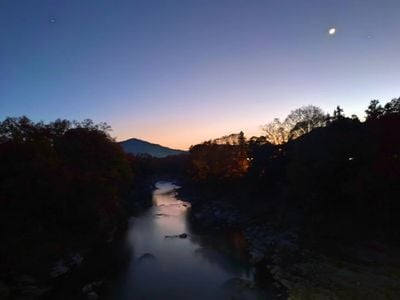
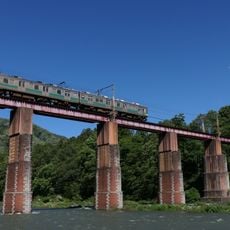
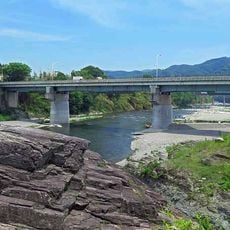
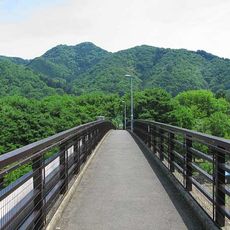
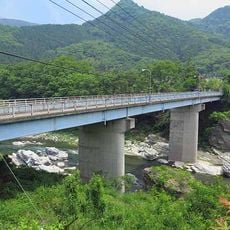
Nagatoro Valley is a canyon cut by the Arakawa River through the Chichibu mountains in Saitama Prefecture. Its core is a 500-metre-long, 10-metre-wide rock terrace called Iwadatami on the left bank, where crystalline schist of the Sanbagawa metamorphic belt lies exposed. Opposite rises the Chichibu Red Wall, a cliff about 100 metres high and 500 metres long, named after the Yangtze's Red Cliff. The river winds between dark, wooded banks, with low hills and a mountain profile beyond.
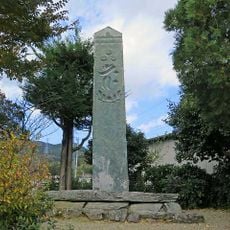
In 1878 the German geologist Heinrich Edmund Naumann led a survey team to Nagatoro and recognised the high geological value of the site, which became a base for Japanese geological research and is called the birthplace of Japanese geology, marked by a stone monument in front of the Saitama Museum of Natural History. On 9 December 1924 the area was designated a Place of Scenic Beauty and Natural Monument under the name Nagatoro.
The name Nagatoro predates the modern era, referring to the long, slow current (nagi) that runs between the rocks of Iwadatami. Since 1916, when Miyazawa Kenji visited on a field trip from Morioka Higher Agricultural School, the valley has entered Japanese literature: his poem about the tiger-striped Toraiwa rock is carved on a stele at the riverbank, erected in September 2003. A second stele carries a haiku by Takahama Kyoshi, composed after a 1930 tour hosted by the Chichibu Railway.
The valley is best explored on foot, with walking paths along the river offering different views of the formations. Sturdy shoes are recommended since some paths cross stones and uneven ground.
The name Iwadatami comes from the flat, layered slabs of schist on the Arakawa's left bank, which stretch about 10 metres wide and 500 metres south from Nagatoro Station and resemble tatami mats laid in rows. The rock belongs to the Sambagawa metamorphic belt, formed deep underground under high pressure and later exposed at the surface.
The community of curious travelers
AroundUs brings together thousands of curated places, local tips, and hidden gems, enriched daily by 93,850 contributors worldwide.