Azusami Tenjinsha, Shinto shrine in Mizuho, Tokyo, Japan
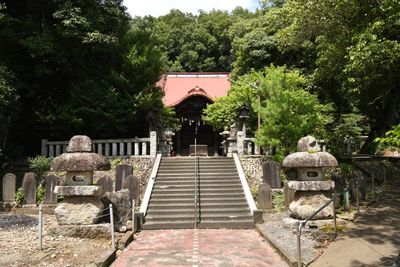
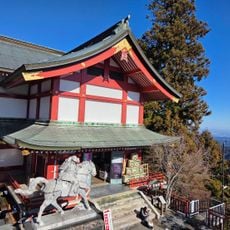
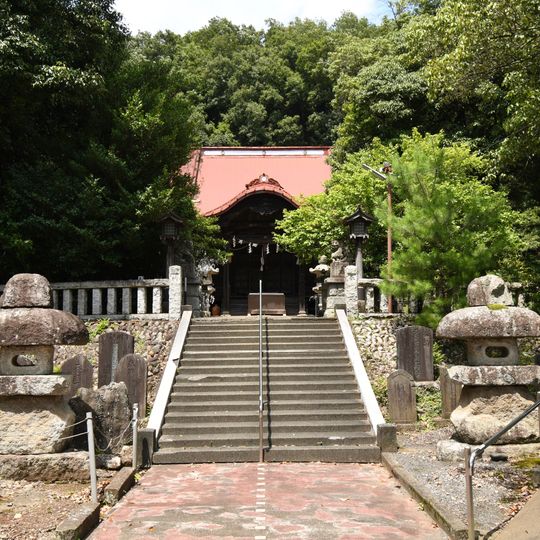
Azusami Tenjinsha is a Shinto shrine in Mizuho, Tokyo, on the southern slope of the Sayama Hills near the border with Musashimurayama. A wide flight of grey stone steps leads up to a nagare-zukuri hall with a reddish-orange gabled roof, a white ridge and a curved crest. Below the roof, a dark wooden facade with a curved gable holds a closed door and a bell rope, and a wooden offering box stands in front.
According to shrine tradition, the shrine was founded in 892 by Takamochi-ō, ancestor of the Kanmu Heike. It served as the tutelary shrine of Murayama-gō and was venerated by the Murayama clan, one of the Musashi Seven Parties. Repairs are recorded in 1584 and 1598, and during the Kyōhō era (1716–1736) Murayama Tosa-no-kami restored the shrine buildings. The Later Hōjō donated 15 kanmon of shrine land and the Tokugawa shogunate 12 koku of shuinchi; in 1873 it was ranked as a gōsha.
The shrine follows the nagare-zukuri style, which is recognizable by a roof that slopes down further on one side than the other. Visitors can take part in simple rituals such as ringing a bell or bowing before the main sanctuary.
The shrine is open during daylight hours and is located in a residential area of Mizuho. Visitors should move quietly and remove their shoes if they wish to enter any indoor area of the main building.
The shrine is the head shrine of other Azusami Tenjinsha, and its name has several proposed origins: a catalpa bow (azusa-yumi), the catalpa tree (kisasage, formerly azusa), or sweet spring water (azu meaning sweet, mi meaning water). The grounds hold subsidiary shrines including an okumiya, Shinmeigu, Hachimansha, Kumano-sha, Raijin-sha, Inari, Itsukushima-sha, Suga-jinja and Kashiko-sha.
The community of curious travelers
AroundUs brings together thousands of curated places, local tips, and hidden gems, enriched daily by 94,075 contributors worldwide.