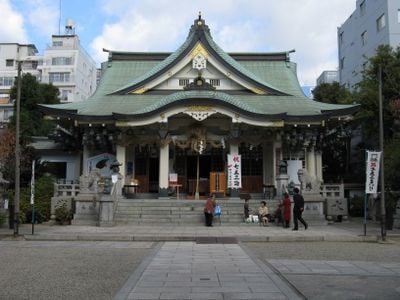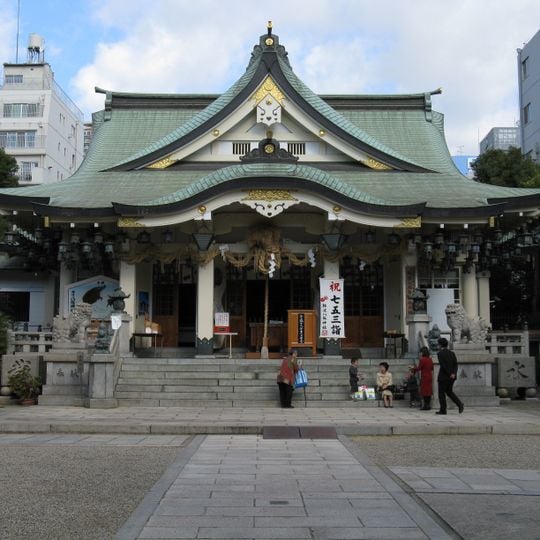
Namba-yasaka Shrine, Shinto shrine in Namba district, Osaka, Japan.
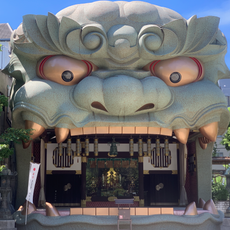
Namba-yasaka-jinja is a shrine in Namba that has become one of the most photographed sites in Osaka, with its towering lion head built from concrete and wood. The head rises several stories high and opens its mouth over a stage where events and prayers take place inside.
Tradition holds that the shrine began in the reign of Emperor Nintoku, when an epidemic swept the area and Gozu Tenno appeared and was worshipped here. It was long known as Namba-shimomiya, and by the Enkyu era (1069-1073) it was famous, with a jinguji and twelve sub-temples. The temples were abolished after the Meiji Restoration's separation of Shinto and Buddhism, and in 1872 it became a village shrine. The shrine buildings burned in the first Osaka air raid of 13-14 March 1945; the present main hall was completed in May 1974.
The shrine's name is often misspelled as Namba Yasaka; the correct form is Namba Yasaka with the character 阪. Its main festival, the Namba Gion Matsuri, runs from 12 to 14 July, with a boat procession on the 12th, a eve celebration on the 13th and a land procession on the 14th. On the third Sunday of January, the Tsunahiki Shinji tug-of-war rite, designated an intangible folk cultural property of Osaka in 2001, is held.
The walk from the station passes through residential streets and takes about eight minutes, with the lion head visible from a distance. The courtyard remains open during daylight hours, with the quietest moments in the morning and early evening.
The lion-head stage, completed in May 1974, measures 12 m high, 11 m wide and 10 m deep, and its design may owe something to temple styles seen in Taiwan. It doubles as a stage for performances and enshrines the rough spirit (aramitama) of Susanoo. A monument on the grounds holds the gun breech cover of the battleship Mutsu.
The community of curious travelers
AroundUs brings together thousands of curated places, local tips, and hidden gems, enriched daily by 93,535 contributors worldwide.