Tennō-ji Temple, Tendai Buddhist temple in Yanaka, Tokyo, Japan
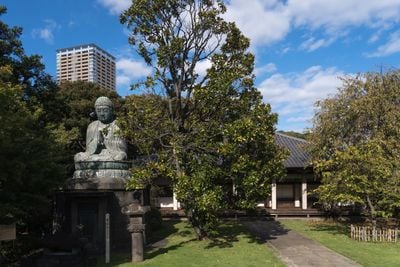
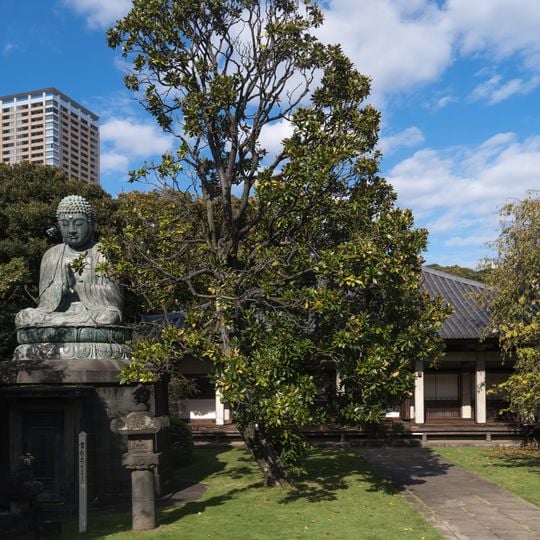
Tennō-ji is a Tendai Buddhist temple in Yanaka, Tokyo, founded in 1274 by Nichigen. Its entrance is a gate with a flat dark beam on two grey concrete pillars; the right pillar bears a white five-petal emblem and the characters 長田山 and 天王寺. On the grounds, a seated Buddha cast in 1690 in weathered green-grey metal sits cross-legged on a lotus base atop a tiered pedestal, with a stone lantern and an inscribed stone marker nearby.
The temple was founded in 1274 and later underwent a significant religious transformation when it shifted from Nichiren Buddhism to Tendai Buddhism in 1698. This change shaped the spiritual direction of the site for centuries to come.
The temple houses a statue of Bishamonten, one of the seven lucky deities that visitors encounter on a pilgrimage route through the Yanaka neighborhood. The statue draws people who come to visit this location as part of that traditional journey.
The temple stands about 20 metres from the south exit of JR Nippori Station, roughly a two-minute walk; Chiyoda Line Sendagi Station is about 950 metres away. Part of the former grounds became Yanaka Cemetery in 1874, and the two are linked by a tree-lined path. The gate pillars carry the inscription Nagatayama Tennō-ji.
The temple's fortune lottery, licensed by the shogunate in 1700, was ranked alongside Meguro Fudō and Yushima Tenjin as one of Edo's three great lotteries. Bans in 1728 and 1842 failed to stop it earlier; the 1842 Tenpō reform finally ended the draws. Related documents are now a Taitō City cultural property.
The community of curious travelers
AroundUs brings together thousands of curated places, local tips, and hidden gems, enriched daily by 93,451 contributors worldwide.