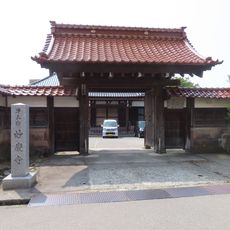
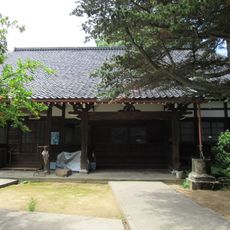
Takamimusuhi-jinja, Shinto shrine in Japan
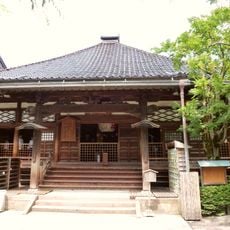
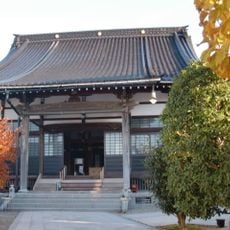
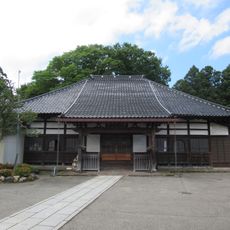
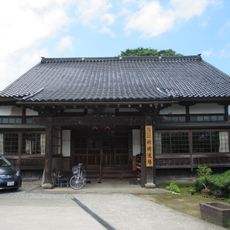
Takamimusuhi-jinja is a former village shrine in Nonoichi, Ishikawa Prefecture. Its worship hall, rebuilt in 1911, is unusually large for a village shrine at five bays wide and five deep, with a hip-and-gable roof, a Chinese-style gable over the entrance, and a railing around the perimeter. The hall's carvings were made by the Kamo Sculpture Workshop led by Kamo Banzan of Inami, Toyama. A small stream, the Kuroda Canal, crosses the grounds under a stone drum bridge.
In 1909, under the shrine merger ordinance, the old Takamimusuhi shrine in western Oshino was combined with Shimizu Shrine in the east to form today's shrine. A new hall was built on the site of the Oshino Gotō family residence and the deities were moved there in 1911. The land was donated by Gotō Otokichi, the family's 11th head, and construction was paid for with the sale of Oshino-yama, a shared outlying plot bought by the army in 1910.
The shrine's name comes from Takamimusuhi-no-Mikoto, one of the first three deities to descend to Takamagahara when heaven and earth split, a genderless hitorigami. The grounds hold a small stone drum bridge over the Kuroda irrigation channel, which divides the old Oshino settlement into east and west. Until the Meiji era each side kept its own mushi-okuri drum, and the two competed across the stream over the loudness and tone of their drumming.
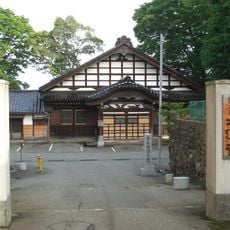
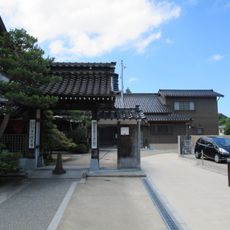
The shrine stands in the Oshino 1-chome district of Nonoichi, Ishikawa Prefecture. The Kuroda irrigation channel runs north-south through the middle of the grounds, crossed by a small stone drum bridge, so visitors pass over the water between the two halves of the precinct. The grounds have shrunk since 1949 because of repeated widening of the Miyanaga-Yokogawa prefectural road alongside the shrine.
The shrine grounds are crossed north to south by a small stream, the Kuroda irrigation channel, spanned by a little stone drum bridge. The east and west halves of the Oshino settlement long competed over everything, and until the Meiji period each side kept its own insect-driving drum; the sounds were compared across this stream. When the two shrines merged, the worship hall was turned to face west to reconcile the residents.
The community of curious travelers
AroundUs brings together thousands of curated places, local tips, and hidden gems, enriched daily by 94,062 contributors worldwide.