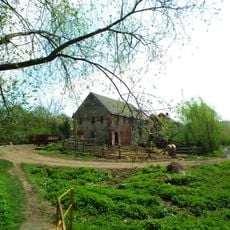
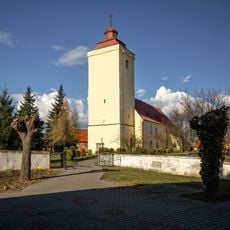
Pałac Warmątowice Sienkiewiczowskie, Baroque château in Warmątowice Sienkiewiczowskie, Poland.
Pałac Warmątowice Sienkiewiczowskie is a two-storey Baroque palace built in the 17th century on a rectangular plan and covered by a tall hipped roof. The main entrance sits in a stone portal between pairs of Ionic columns, topped by a cartouche with the coats of arms of von Seherr-Thoss and von Kreckwitz. The palace forms part of a complex with an 18th-century park, a garden pavilion, and farm buildings.
The palace was built starting in 1602 by Wenzeslaus von Zedlitz on the site of a medieval defensive manor, receiving Renaissance-style features. Later modifications transformed it into the Baroque structure that stands today.
Alfred von Olszewski, the last male owner, admired Nobel laureate Henryk Sienkiewicz and stipulated that his heirs must prove command of Polish and knowledge of Polish history and culture by age 30. His children refused, and Sienkiewicz declined the inheritance. In February 1998 the village was renamed Warmątowice Sienkiewiczowskie in memory of this episode.
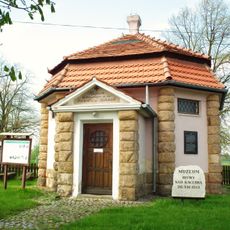
The palace is a private residence that also runs as a small hotel, so visits depend on the owners' arrangements. The grounds include an 18th-century park and a garden pavilion from the mid-18th century. The estate lies about nine kilometres southwest of Legnica, near the A4 motorway.
On 26 August 1813 Blücher set up his headquarters at the palace before the Silesian Army under his command defeated the French at the Battle of the Katzbach. An obelisk with an inscription stands in front of the building in memory of this. The village was renamed Warmątowice Sienkiewiczowskie in February 1998 because of the Sienkiewicz inheritance episode.
The community of curious travelers
AroundUs brings together thousands of curated places, local tips, and hidden gems, enriched daily by 94,460 contributors worldwide.