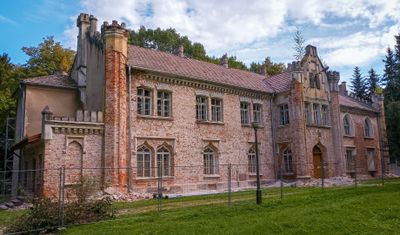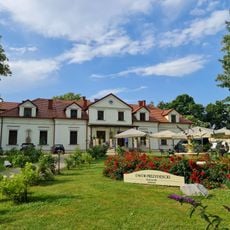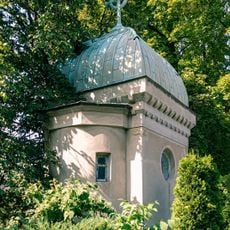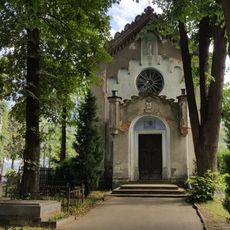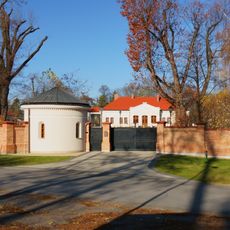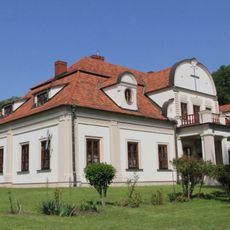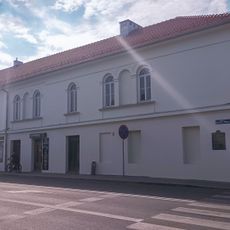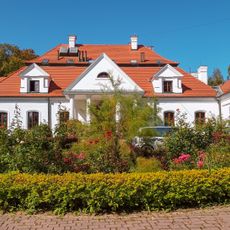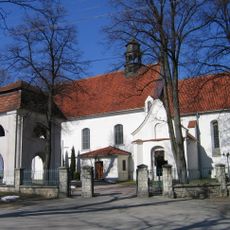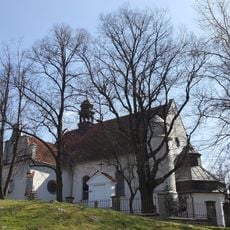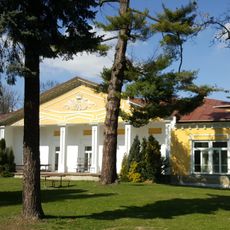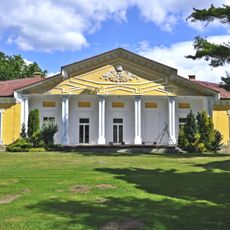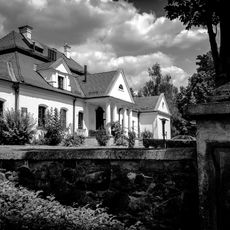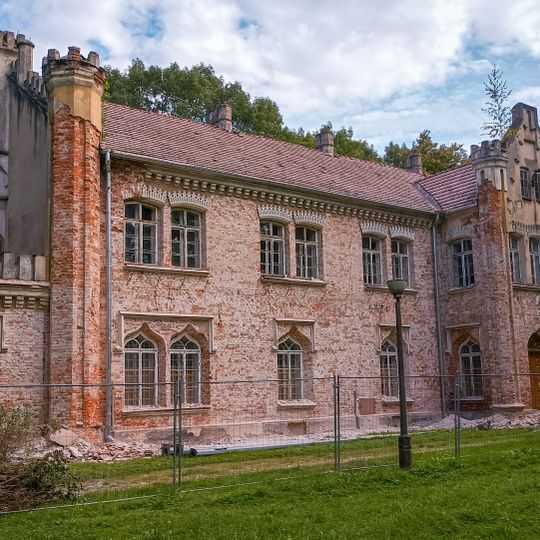
Dąmbski Palace, Gothic Revival palace in Wojnicz, Poland.
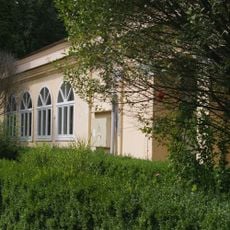
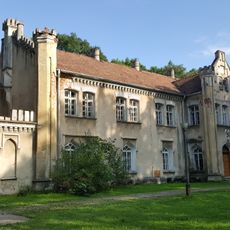
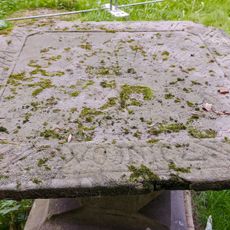
Dąmbski Palace is a brick palace built in 1876 in the English Neo-Gothic style to a design by Karol Polityński. Its rectangular plan has a west-facing front with a projecting bay and main entrance, while the east side has a columned portico facing the Dunajec valley. The roof is gabled with stepped gables, corner turrets with crenellations, pointed-arch windows and three sundials, now faintly visible.
The present palace was built in 1876 for Władysław Dąmbski on the site of a wooden manor linked to the January Uprising; Dąmbski was arrested for patriotic activity and spent two years in prison. After his death in 1877 the estate passed to his wife from the Jordan family. From 1936 a agricultural school operated here, continuing after World War II until 1962; later uses included a girls' dormitory and a kindergarten, and the building stood abandoned in the 1990s. The gmina of Wojnicz acquired it in 2011 and a full renovation began in 2022.
The estate's name recalls the Dąmbski family: Władysław Dąmbski, arrested for patriotic activity and imprisoned for two years, built the palace in 1876 and died a year later. His wife, from the Jordan family, inherited it; after the Jordans went bankrupt in 1934 the Brzesko district administration took over. From 1936 a farming school occupied the building, continuing after the war until 1962.
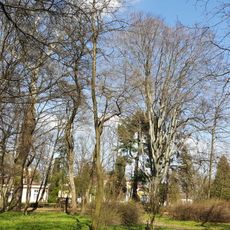
The mansion sits at the edge of Wojnicz and is accessible on foot from the town center. Visitors should note that the grounds are partially surrounded by private property and may not always be entirely open to the public.
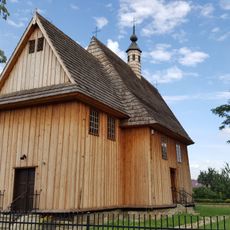
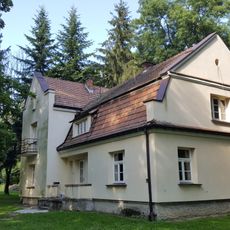
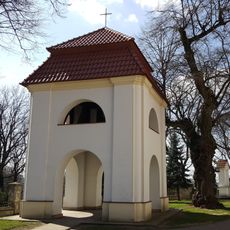
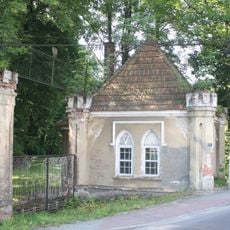
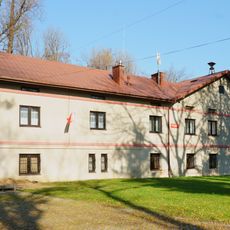
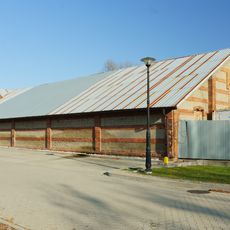
The complex includes additional buildings from different periods, such as a guardhouse from 1874 and a villa erected in the early 1900s. This mix of structures shows how the estate grew and expanded over several decades.
The community of curious travelers
AroundUs brings together thousands of curated places, local tips, and hidden gems, enriched daily by 94,631 contributors worldwide.