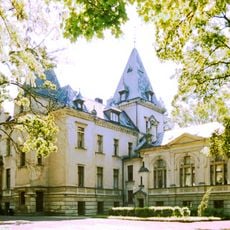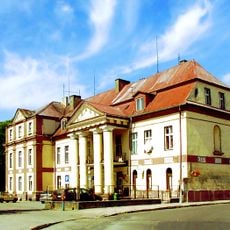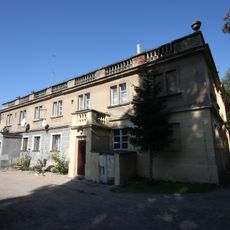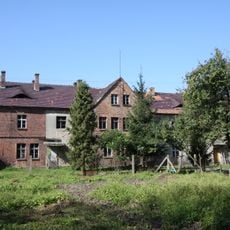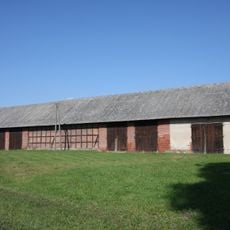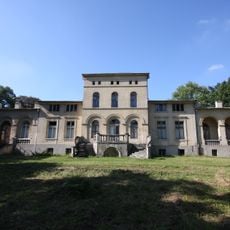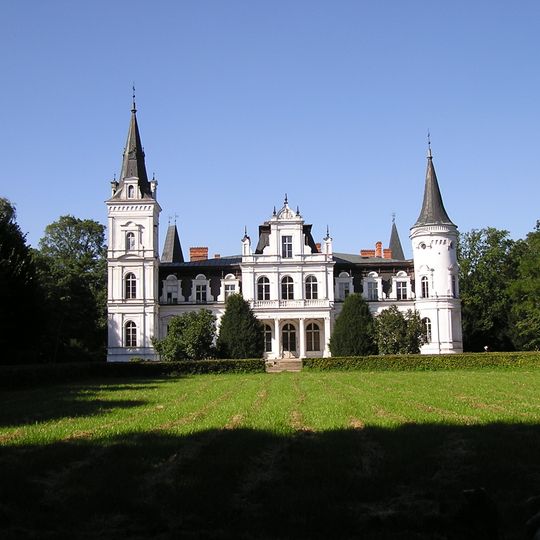
Posadowo Palace, 19th-century palace in Nowy Tomyśl County, Poland.
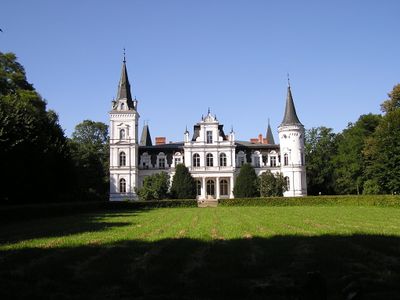
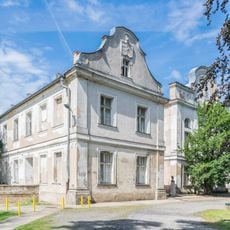
Posadowo Palace is a brick, stuccoed palace built in 1869–1870 by Stanisław Hebanowski for Count Władysław Łącki in the French Neo-Renaissance style. Its rectangular plan has two storeys plus a mansard roof, two-storey projections with Renaissance gables and balconied porticoes, and four towers of differing heights and forms. The front elevation carries the Korzbok-Łącki and Drogosław coats of arms.
The present palace was built in 1869–1870 for Count Władysław Łącki by architect Stanisław Hebanowski, probably from designs Łącki brought from France. An earlier garden and manor existed in the first half of the 17th century, and buildings of 1844–1847 did not survive. After Władysław's death in 1907, his sons Stefan and Stanisław inherited the estate; in 1937 it passed to their nephew Feliks Tyszkiewicz-Łącki.
The palace's front facade carries the Korzbok coat of arms of Władysław Łącki, three carp, beside the Drogosław arrow of his wife Antonina Skórzewska. Inside, the two-storey octagonal armoury held family and national memorabilia under stucco reliefs; two panels above the east and west doors show the Korzbok and Nowina arms.
The palace stands in the northern part of Posadowo, with the French-style garden and landscape park on its southern side, laid out on terraces along a north-south axis. The whole palace-and-park complex covers 10.6 hectares. A fire on 15 February 2017 caused the ceiling between the ground floor and first floor to collapse, so the building is not open to visitors.
The palace housed the directorate of the Posadowo Horse Stud, and there were plans to open a Horse Museum there, which never materialized. In 1943 the occupiers removed valuable artworks, and in 2001 the heirs of the Łącki family recovered the palace and its garden layout.
The community of curious travelers
AroundUs brings together thousands of curated places, local tips, and hidden gems, enriched daily by 93,737 contributors worldwide.