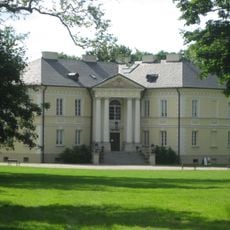
Panteon w Dobrzycy, Classical garden pavilion in Dobrzyca, Poland.
The Panteon in Dobrzyca is a classicist garden pavilion built on a circular plan, with a Tuscan colonnade portico and triangular pediment on its northern side. A flattened dome with a lantern covers the main rotunda, whose interior columns support a round cornice beneath the cupola. Three large windows were added in 1931; the building originally had none.
The Panteon was built around 1795–1799 for General Augustyn Gorzeński, owner of the Dobrzyca estate, to a design by Warsaw architect Stanisław Zawadzki. Its original purpose is unknown: it may have been a Masonic lodge, since Gorzeński held a high rank in Masonic structures, or simply a garden pavilion and orangery. In the early 20th century it served as an ice house, and since 2003 the portico has been moved about 80 cm forward during a renovation.
The Panteon now hosts temporary exhibitions organised by the Museum of Landowners in Dobrzyca. Its name and circular form refer to the Pantheon in Rome, though the building's original purpose remains unknown; early 20th-century uses included a cold store.
The pavilion sits on the southern edge of the palace park in Dobrzyca, close to the orangery and easy to reach from the main complex. The surrounding park area offers the best views of the classical architecture from different angles.
The building's original purpose is unknown. Because General Augustyn Gorzeński held a high rank in Masonic structures and the pantheon motif recurs in Masonic iconography, some early theories linked it to secret Masonic rites; others argue it was simply a park pavilion and the central part of the orangery, perhaps a Kaffehaus. In the early 20th century it served as an ice house.
The community of curious travelers
AroundUs brings together thousands of curated places, local tips, and hidden gems, enriched daily by 94,702 contributors worldwide.