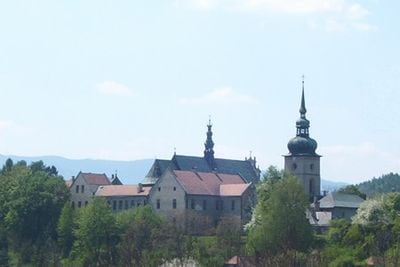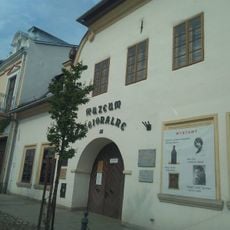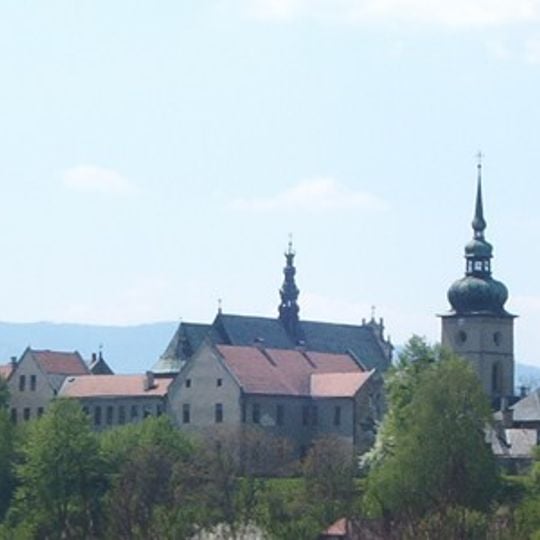
Poor Clare Nuns monastery in Stary Sącz, 13th-century Poor Clare monastery in Stary Sącz, Poland.
The Poor Clare monastery in Stary Sącz stands beside the town, on a steep rise above the Poprad valley. Its buildings form a quadrilateral around a central courtyard, with a cylindrical tower at one corner and a gate tower nearby. The Gothic church of St. Clare, later also dedicated to the Holy Trinity, has a single nave of five bays and a narrower chancel with a rib-vaulted ceiling.
Princess Kinga of Kraków-Sandomierz established the monastery in 1280 and endowed it with the city of Stary Sącz and surrounding lands. The Italian builder Jan de Simoni redesigned the complex in the early 1600s, giving it the baroque style visible today.
The monastery is named for Saint Kinga, who in 1280 gave the town of Stary Sącz and 28 villages to the convent and became a Poor Clare herself. She died there on 24 July 1292, and her tomb is in the monastery. A 17th-century grille called Piotrowa separates the chapel of Saint Kinga, where a memorial tablet thanks for her canonisation and for John Paul II's visit on 16 June 1999.
The monastery stands by the steep edge of the Poprad valley, next to the old town layout, at pl. św. Kingi 1. The complex is entered through a gate tower, with a cylindrical corner tower on the south side; the cloister forms a quadrangle around a central garth. The church of St Clare is single-naved with a five-bay body and a short, narrower chancel.
A wooden statue of Saint Kinga carved from linden wood around 1470 by medieval craftsmen stands in the chapel's baroque altar. This sculpture has survived more than 500 years and shows the skilled artistic work of that era.
The community of curious travelers
AroundUs brings together thousands of curated places, local tips, and hidden gems, enriched daily by 94,451 contributors worldwide.