Museum – Memorial Site in Bełżec, Holocaust memorial museum in Bełżec, Poland
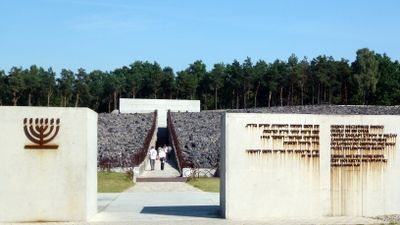
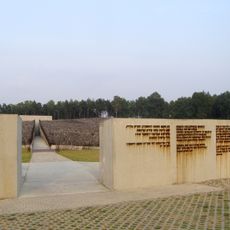
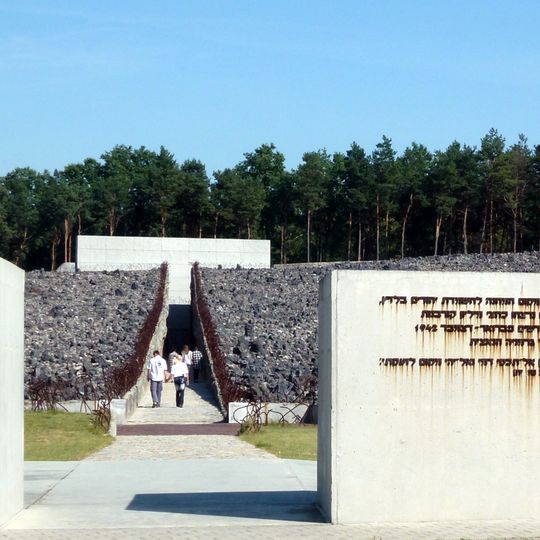
The Museum – Memorial Site in Bełżec occupies the grounds of the former German Nazi extermination camp, where about 450,000 Jews were killed in 1942–1943. The memorial, unveiled in 2004, is a grey stone and concrete complex: a wide paved path runs between two banks of dark, irregular stones toward a tall concrete wall, and a smooth concrete block engraved with Hebrew lettering stands at the front right, with rust-coloured stains running down its face.
The camp opened in March 1942 as the first of three extermination centers built under Operation Reinhard. The extermination operation was halted in mid-December 1942, and by June 1943 the Germans had dismantled the buildings, fences and guard towers, emptied the mass graves and burned the bodies. The first monument was unveiled only on 1 December 1963; the Museum – Memorial Site was established on 1 January 2004 as a branch of the Majdanek State Museum.
The memorial's Hebrew inscription on the concrete block at the entrance and the rows of concrete urns with metal covers symbolising flames mark the graves found at the site. The 1963 crypt-mausoleum, covered in artificial stone panels, held remains and objects recovered from the camp. A plaque added in the early 1980s stated that 600,000 Jews and about 1,500 Poles were murdered here.
The museum is open several days a week and visitors should allow adequate time to view the exhibitions thoughtfully. Those visiting should wear appropriate clothing and sturdy footwear for walking across the grounds.
Rudolf Reder was one of only two people who survived Bełżec, and his accounts provided crucial information about what occurred there. His testimony ranks among the most valuable records for understanding the operations of this camp.
The community of curious travelers
AroundUs brings together thousands of curated places, local tips, and hidden gems, enriched daily by 94,004 contributors worldwide.