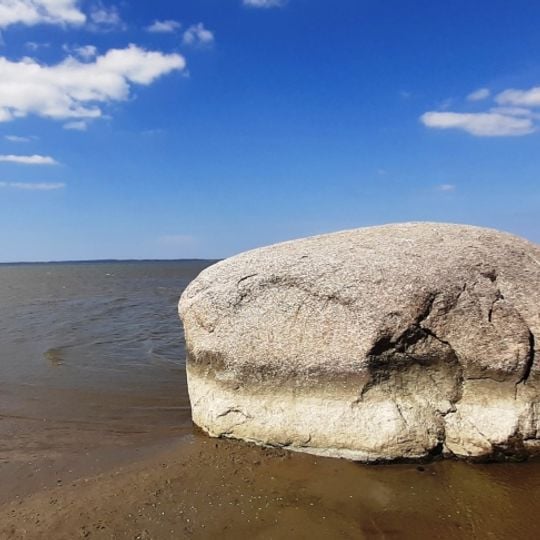
Święty Kamień, Gneiss boulder in the Vistula Lagoon, Poland
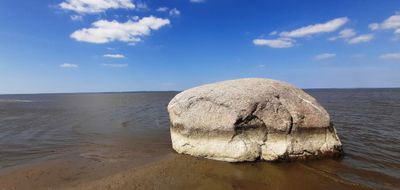
Święty Kamień is a gneiss erratic boulder standing in the waters of the Vistula Lagoon about 25 m from the beach, roughly 4 km from Tolkmicko toward Frombork. It rises 2.30 m above the water, about one metre of it submerged, and has a circumference of 14.25 m. Its eye-shaped gneiss shows light grey and pinkish feldspar packets with dark mineral streaks.
During the pre-Christian era, the Pogezan tribe used this stone as an altar for offerings, particularly fish, to honor Kurche, their fertility god. The boulder thus stands as evidence of the ritual practices that were central to this early population's beliefs.
The boulder was a cult site of the Prussians, dedicated to Curche, the god of fertility and harvest. Offerings of the first caught fish, threshed grain, honey and milk were placed in a bowl-shaped hollow on its upper surface. The 16th-century chronicler Simon Grunau, probably born in Tolkmicko, described this cult.
The boulder lies about 25 m from the beach, a distance that shifts with the water level of the Vistula Lagoon; the water at the stone is only ankle- to thigh-deep, so wading out is easy. It stands roughly 4 km from Tolkmicko on the Frombork road, just outside the historic Warmia border. The Green Velo cycling route, section "Święty Kamień", opened nearby in 2015.
The boulder is an augen gneiss, a metamorphic rock with light grey and pinkish feldspar lenses and dark bands of pyroxene, amphibolite and biotite. Its circumference is 14.25 m and its height 2.30 m, about one metre of it below the waterline; how deep it sits in the ground has not been measured. It has been a protected nature monument since 1977.
The community of curious travelers
AroundUs brings together thousands of curated places, local tips, and hidden gems, enriched daily by 94,822 contributors worldwide.