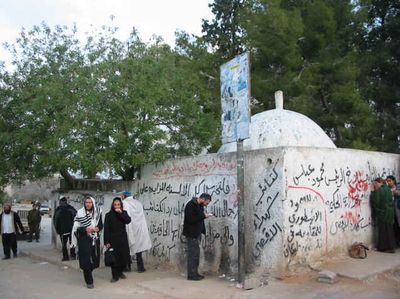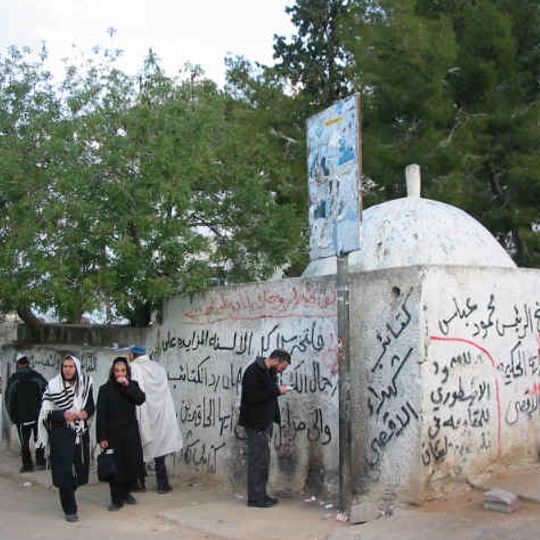
Tomb of Joshua, Holy mausoleum in Kifl Hares, Palestine
The Tomb of Joshua, known to Muslims as the Maqam of Yusha ibn Nun, is a single domed room measuring 3 by 3.8 metres, entered from a 4.2 by 5.3 metre courtyard through a narrow, low passage. A large old Palestinian terebinth grows in the courtyard, and the whitewashed walls carry Arabic graffiti, including the words for "barrier" and "death".
The current shrine is an Islamic structure built by Sultan Saladin, as recorded on a wall plaque naming Jawhar ibn Abdullah as one of its servants. Palestinian historian Murad Mustafa Dabbagh dated that man's proxy pilgrimage for Najm al-Din Ayyub to 610 AH (1213/14 CE), placing the building in the Ayyubid period. A 1258 account by Rabbi Jacob, envoy of Rabbi Jechiel of Paris, is the earliest to identify Kifl Haris with Joshua's tomb.
Jews call the shrine the Tomb of Joshua and pray there on 26 Nisan, the anniversary of his death, as well as during Chol HaMoed and around Shabbat Shelach. Muslims know it as the Maqam of Yusha ibn Nun, and some also call it the Maqam of the Servant of Saladin. The village's other shrines are linked to Caleb and to Nun, Joshua's father.
Jewish visits centre on 26 Nisan, during Chol HaMoed and around Shabbat Shelach. On those days the Israeli army and Border Police take over Kifl Haris from midday to evening, residents are confined indoors and barred from looking out of windows, so access is tied to those closures.
The shrine is also known as the Maqam of the Servant of Saladin. A plaque on its wall named Jawhar ibn Abdullah as one of the shrine's servants; the historian Murad Mustafa Dabbagh linked him to the Hajj performed in 610 AH (1213/14 CE) for Najm al-Din Ayyub, which dates the building to the Ayyubid period. The plaque disappeared in the second half of the 20th century.
The community of curious travelers
AroundUs brings together thousands of curated places, local tips, and hidden gems, enriched daily by 94,852 contributors worldwide.