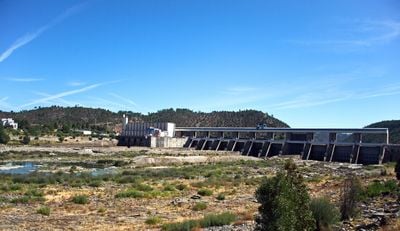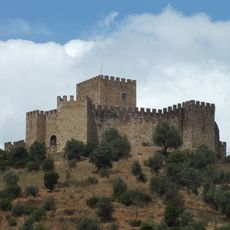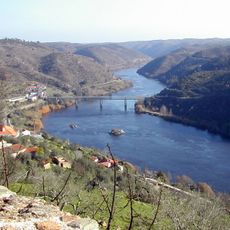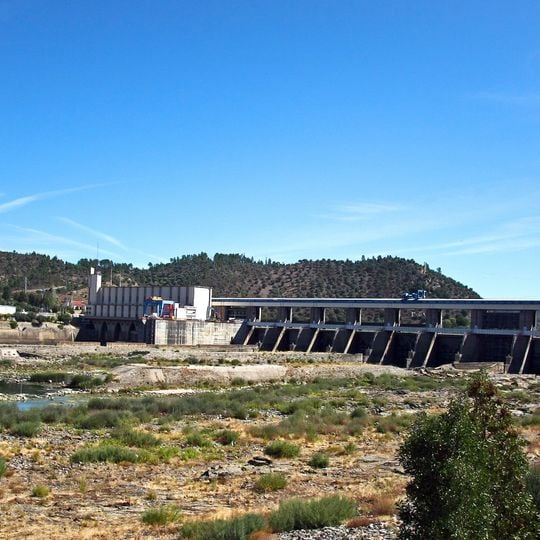
Belver Dam, Hydroelectric power station in Gavião e Atalaia, Portugal.
Belver Dam is a 30-metre-high concrete gravity dam on the Tagus, 327.5 metres long along its crest, completed in 1952. Its body holds ten roller gates, and a tall ribbed intake tower stands at the left end. The downstream face is stepped with sloped buttresses, and a white-lined roadway runs across the top.
Construction started in 1945 as Portugal worked to rebuild and modernize after World War Two. The project reflected the nation's strategy to develop renewable power sources and support industrial growth.
The reservoir submerged a stretch of the old Tagus towpath, the muro de sirga, where teams of men once hauled boats upstream. Belver also received Portugal's first fish passage in 1947, a Denil-type structure later replaced by the present lock, which a 1990s study found largely ineffective.
The dam lies on the Tagus where it forms the border between Portalegre and Santarém districts, in Gavião municipality. The structure is an operating power station owned by HIDROTEJO and operated by EDP, so access to the dam itself is not open to visitors. The reservoir's full level is 46.15 m, with a minimum operating level of 41 m.
The dam created a large artificial lake that completely reshaped the valley landscape and now serves as a central feature of the Tagus region. Many visitors do not realize how this reservoir influenced the local climate and became a habitat for water birds.
The community of curious travelers
AroundUs brings together thousands of curated places, local tips, and hidden gems, enriched daily by 93,174 contributors worldwide.