Humor Monastery, Orthodox monastery in Gura Humorului, Romania
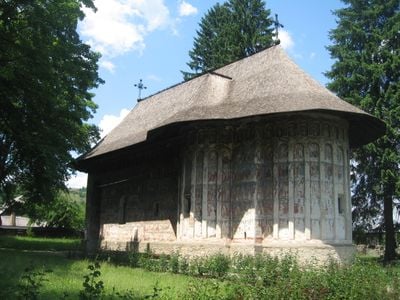
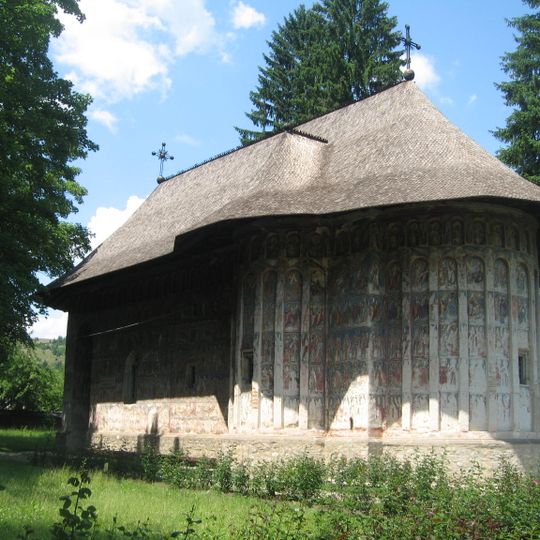
Humor Monastery is an Orthodox place of worship in the Gura Humorului region with painted exterior walls showing biblical and historical scenes in reddish-brown tones. The structure features a cross-shaped shingled roof without a steeple and sits within a stone boundary wall.
The monastery was founded in the 1530s when a local leader and his chancellor commissioned its construction. This foundation built upon earlier religious structures that had already existed at the site.
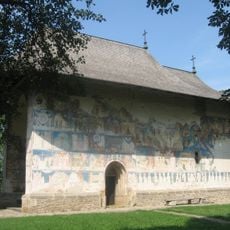
The exterior frescoes were painted in 1535 by a team that included Toma of Suceava, and their dominant reddish-brown tone sets Humor apart from other Moldavian monasteries. The Siege of Constantinople panel shows the Persians as Turks, a political reading of the 626 siege. The monastery is now a nuns' community, reopened in 1990 after closing in 1786.
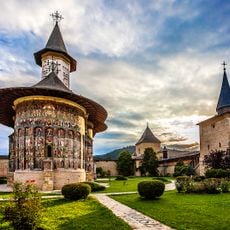
The monastery lies about 5 km north of Gura Humorului, in Mănăstirea Humorului village. The painted church stands inside the stone walls raised by Vasile Lupu in 1641, with the bell tower from the 19th century and the 1641 Vasile Lupu Tower in the same enclosure. The ruins of the old church, Humorul Vechi, are about 100 m south-west of the present precinct, and the 16th–18th century monastic house ruins lie within it.
The 1473 Tetraevangelion given by Stephen the Great was found at Humor in 1881 by Bishop Melchisedec Ștefănescu, who argued its miniature was the ruler's true portrait; Bogdan Petriceicu Hasdeu contested him. The manuscript is now kept at Putna Monastery. The monastery is home to nuns, not monks.
The community of curious travelers
AroundUs brings together thousands of curated places, local tips, and hidden gems, enriched daily by 94,750 contributors worldwide.