Antim Monastery, Orthodox monastery in Bucharest, Romania
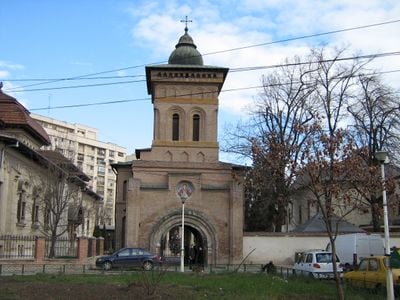
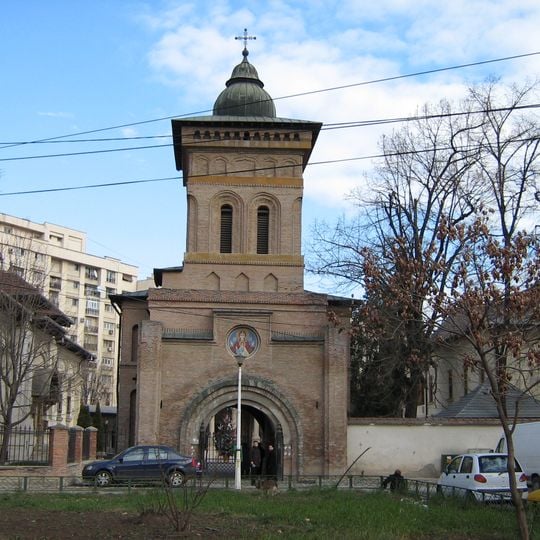
Antim Monastery is a walled complex in central Bucharest whose church, built 1713–1715, has a trefoil plan, large windows with carved stone frames, and a single tower with a rounded green dome. The brick facade carries lighter stone bands and a mosaic above the deep arched entrance. Cells once formed a square perimeter with corner turrets.
The monastery was founded in 1713 by Metropolitan Anthony of Iveria on the site of an earlier wooden church, with construction completed and consecrated by 1715. This founding period marked an important moment in Romanian Orthodox architecture and institutional development.
The monastery houses the Synod Library and serves as a residence for patriarchal vicar bishops, making it an active center of Romanian Orthodox administration. Visitors can sense this institutional role through the ongoing religious activities and the presence of clergy throughout the complex.
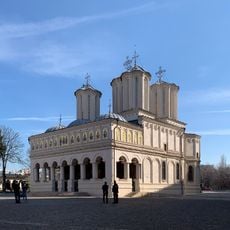
Antim Monastery stands at Mitropolit Antim Ivireanu Street no. 29, about 200 metres west of the Patriarchal Cathedral. The complex is a historic monument (LMI code B-II-a-A-18971) and also houses part of the patriarchal administration and the Holy Synod library, so some buildings are working offices rather than visitor areas.
Above the entrance door, beneath the Greek inscription, a carved snail forms the emblem of Saint Anthim, framed by a laurel wreath with a star above it. The same snail shape was used for the church's first door key, whose iron lock mechanism has been kept in the National Museum since 1855.
The community of curious travelers
AroundUs brings together thousands of curated places, local tips, and hidden gems, enriched daily by 93,194 contributors worldwide.