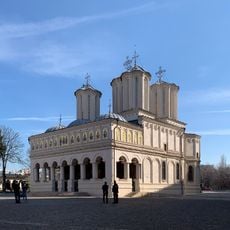
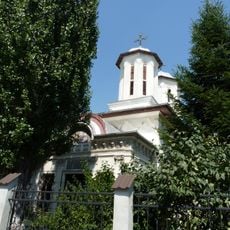
Palace of the Patriarchate, Religious edifice on Mitropoliei Hill, Bucharest, Romania.
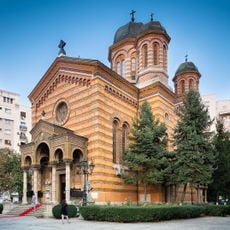
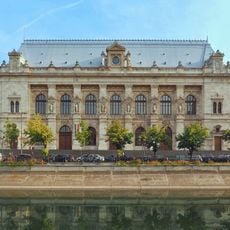
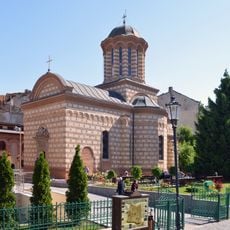
The Palace of the Patriarchate stands on the Mitropoliei plateau, its 80 m neo-classical façade centred on a recessed entrance peristyle of six Ionic columns grouped in pairs. A raised, windowed cupola topped by an eagle rises above the assembly hall, echoing the Romanian Athenaeum. Seen from United Nations Street, four levels appear: a massive stone base, a carved second level, and the entrance level facing the cathedral.
The building was constructed in the early 1900s and originally functioned as a parliamentary seat before becoming the center of Orthodox Church leadership. This shift in use reflects broader changes in how the city's institutions were organized during that period.
The hill was covered with the voivodes' and Metropolitanate monks' vineyards around 1650. The Metropolitan was ex officio president of the boyars, the only citizens with the right to vote, and could not leave his residence, so legislative sessions were held at the Metropolitanate; part of the monks' cells became the assembly building.
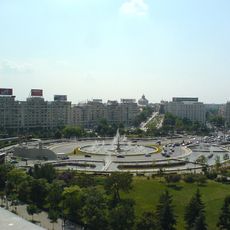
The palace is generally not open to regular visitors since it functions as an active administrative center with security restrictions. You can view the exterior and the surrounding plaza, which gives you a good sense of the building's scale and design from outside.
The palace stands on Dealul Mitropoliei, where the Metropolitan was ex officio president of the boyars, the only citizens with voting rights. Because tradition held that the Metropolitan could not leave his residence, part of the monks' cells was converted into a hall for official legislative sessions.
The community of curious travelers
AroundUs brings together thousands of curated places, local tips, and hidden gems, enriched daily by 93,152 contributors worldwide.