Piața Unirii, Central square in Bucharest, Romania
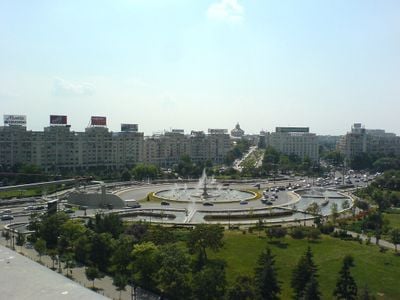
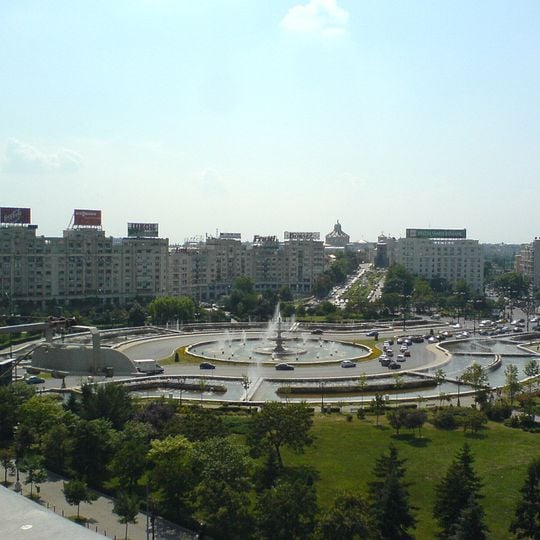
Piața Unirii is a large central square in Bucharest featuring expansive open areas, a prominent fountain complex, and commercial and residential buildings surrounding the space. The plaza spans multiple zones and sits at the junction where four city sectors meet and connect.
Construction began in December 1934 and the square opened on 15 October 1935 as Piața Națiunii, part of mayor Dem I. Dobrescu's plan to cover the polluted Dâmbovița. It incorporates the older Coșbuc and Șerban Vodă arched bridges. Renamed Piața Unirii in 1959, it was later bisected by Unirea Boulevard, built under Communism as the Boulevard of the Victory of Socialism.
The square's name changed repeatedly: Piața Mare in the 19th century, Piața Națiunii after 1918, then Piața "8 iunie" and "6 septembrie" after the kings' accession days, "28 martie" from 1950, and finally Piața Unirii in 1959, marking 100 years since the Union of the Principalities.
The square is well served by public transportation, including metro lines, bus routes, and tram connections that link different parts of the city. Visitors should plan time to explore the various zones since the area spans a substantial distance.
The square caps the Dâmbovița River: the Union Floor is a reinforced concrete deck 32 m wide and 360 m long running diagonally beneath the plaza. In 2023 engineers found exposed rebar and crumbling concrete in it, and traffic over 3.5 tonnes was banned; a reconstruction permit was approved on May 27, 2024.
The community of curious travelers
AroundUs brings together thousands of curated places, local tips, and hidden gems, enriched daily by 94,637 contributors worldwide.