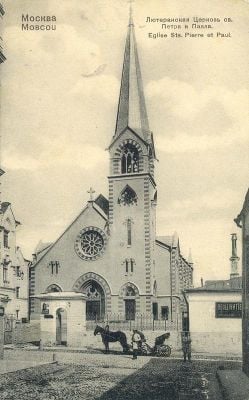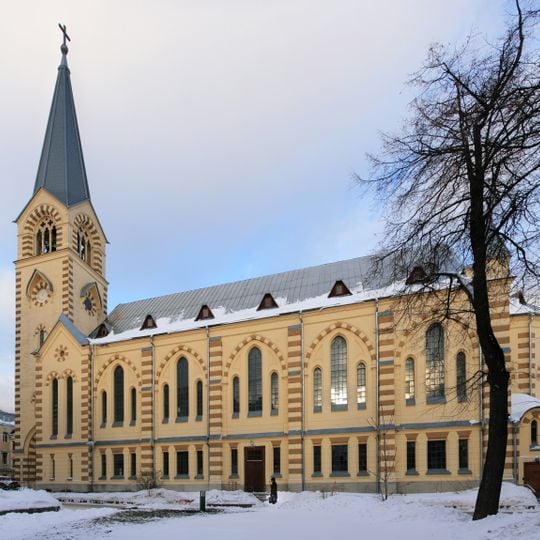
Moscow Lutheran Cathedral, Lutheran Cathedral in Basmanny District, Moscow, Russia
Moscow Lutheran Cathedral is a Gothic Revival church in Starosadsky Lane, built 1903–1905 to a design by William Walcott, completed by engineer Artur Loleit after architect Viktor Kossov resigned. Its pale yellow walls are banded with darker ochre stone; a square tower with a clock and a steep grey spire stands on the left, and the long body has pointed dormer vents and tall arched windows. The interior holds a Walcker organ from 1892, later replaced by the 1898 Sauer organ from St. Michael's Church.
The parish was founded in 1626 when pastor Jakob Neuenburg split from the St. Michael congregation. After Tsar Alexei Mikhailovich granted the land in 1670, a stone church with a bell tower was consecrated in 1695 in the presence of Peter the Great; it burned in 1711, 1737, 1748 and finally in the 1812 fire. In 1817 the community bought the Lopukhin estate in Starosadsky Lane, and on 15 June 1818, with King Frederick William III of Prussia present, the cornerstone of a new church was laid, consecrated on 18 (30) August 1819. The present building was erected in 1903–1905 to William Walcot's design under architect Viktor Kossov, completed by engineer Artur Loleit, and consecrated on 5 (18) December 1905.
Services are held every Sunday at 11:30 in Russian with liturgical elements in German. The congregation, founded in 1626, long included Latvians and Estonians, and worship was once held in German, Latvian and Estonian. Since 8 May 2020 a copy of the Stalingrad Madonna has hung in the church.
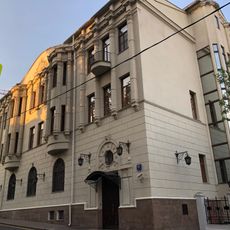
The cathedral stands at Starosadsky Lane 7, in the Basmanny District, a short walk from the Kitay-Gorod metro station. Services are held on Sundays at 11:30 in Russian with some liturgical parts in German. The building is shared with the former school and parsonage next door, which still house FSO and FSB offices, so only the church itself is open to visitors.
The organ now in the cathedral was not built for it: it comes from St. Michael's Church, was made in 1898 by W. Sauer of Frankfurt (Oder) as Opus 755, and was restored in 2005 by Reinhard Hüfken. It has 33 stops on three manuals and pedal. The bells, cast in 1957 by Rincker, came from Rheydt's Friedenskirche in 2005.
The community of curious travelers
AroundUs brings together thousands of curated places, local tips, and hidden gems, enriched daily by 94,227 contributors worldwide.