Kalitnikovskoye Cemetery, Historic cemetery in Tagansky District, Moscow, Russia.
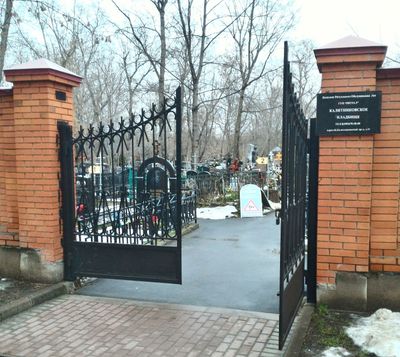
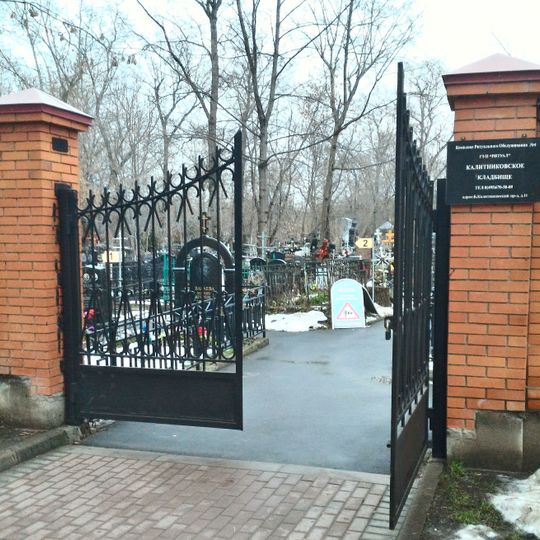
Kalitnikovskoye Cemetery covers about 19 hectares at Bolshoy Kalitnikovsky Prospekt 11 in Moscow's Tagansky District. Its entrance is a wide black metal double gate with pointed tops, hung between orange brick pillars with light stone bases and reddish pyramidal caps; a dark sign on the right pillar reads "КАЛИТНИКОВСКОЕ КЛАДБИЩЕ" with the dates 11.11.1896 and 30.01.2017.
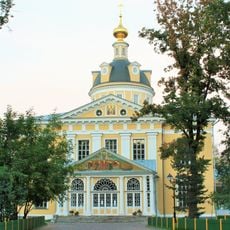
Founded in 1771, after a plague epidemic led to a ban on burials inside Moscow, the cemetery was one of several laid out beyond the Kamer-Kollegiya rampart, alongside Rogozhskoye, Vagankovo and Danilovskoye. Its wooden church burned and was rebuilt repeatedly; the stone Church of the Theotokos Joy of All Who Sorrow was built in 1834–1838 to a design by N. I. Kozlovsky and rebuilt in 1881 by V. I. Verigin. The church stayed open in Soviet times and returned to the Moscow Patriarchate in 1944.
The name Kalitniki likely comes from craftsmen who made kalitas, leather bags and purses; the name first appears on a 1688 plan as the Kalitenka stream. The stone Church of the Theotokos Joy of All Who Sorrow, built 1834–1838 to a design by N. I. Kozlovsky and rebuilt in 1881 by V. I. Verigin, stayed open through Soviet times and was a centre of the Renovationist movement until 1944. A memorial pillar with the Bogolyubskaya icon marks the altar site of the earlier wooden church (plot 21).
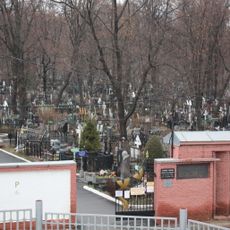
The cemetery lies at Bolshoy Kalitnikovsky Prospekt 11, near the former Ptichy (Kalitnikovsky) market closed in 2001. Reach it by public transport from Taganskaya Square; the closest metro is Volgogradsky Prospekt and the nearest MCD-2 platform is Kalitniki. The grounds cover about 19 hectares, and the ravine that once split the old and new sections still makes the terrain uneven.
The ravine that once split the cemetery's old and new halves was still visible on aerial photographs from the 1940s. In the Perestroika press it was claimed as a mass burial site of executed repression victims; journalist Alexander Milchakov developed the story, while necropolis researcher M. D. Artamonov disputed several of the assumptions without denying that shot people were buried at Kalitniki.
The community of curious travelers
AroundUs brings together thousands of curated places, local tips, and hidden gems, enriched daily by 93,870 contributors worldwide.