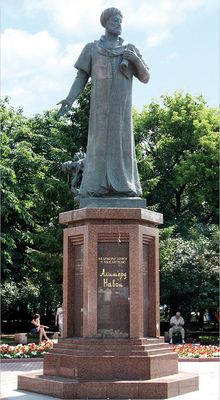
Alisher Navoiy haykali Moskva, Bronze monument in Moscow, Russia.
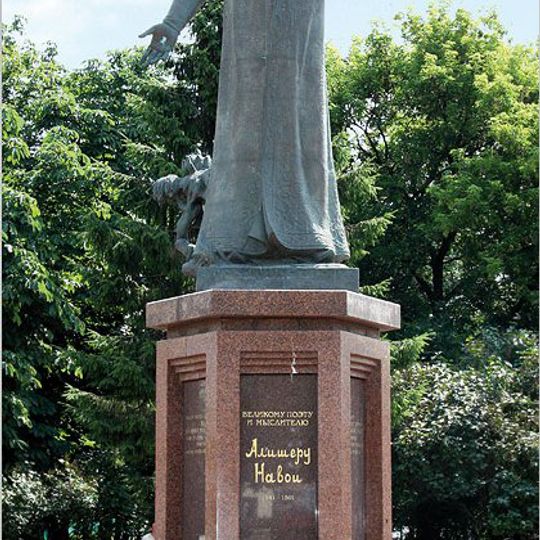
The Alisher Navoiy monument is a 4.5-metre bronze figure of the poet in national dress, standing on a tall polished reddish-brown stone pedestal with angled corners and recessed panels. The front panel bears gold lettering: "ВЕЛИКОМУ ПОЭТУ И МЫСЛИТЕЛЮ", the name "Алишеру Навои" and the dates "1441-1501". A smaller crouching figure is sculpted against the robe at the statue's lower left.
The monument was made in Uzbekistan and given to Moscow by the Uzbek government and Tashkent city administration. Sculptor Ravshan Mirtadzhiev and architects Alexander Kuzmin and Igor Voskresensky designed it. The sculpture arrived by plane on 15 August 2002, and the opening ceremony took place on 26 November 2002 with Mayor Yuri Luzhkov present.
The inscription on the pedestal reads "To the great poet and thinker", with the name Alisher Navoi and the dates 1441-1501. The monument was a gift from the government of Uzbekistan and the Tashkent city administration, delivered by plane to Moscow on 15 August 2002. Navoi, a 15th-century poet, thinker and statesman, is shown in national dress reciting his verses.
The statue stands in the square on Serpukhovskaya Square where it meets the Sadovoye Ring, so it is seen from the roadway and the surrounding sidewalks. The bronze figure rises 4.5 metres above the pedestal, making it visible from a distance; approach on foot for the inscription and the small crouching figure at the poet's feet.
The pedestal's front panel carries gold lettering: "ВЕЛИКОМУ ПОЭТУ И МЫСЛИТЕЛЮ" above the name Alisher Navoi and the dates 1441–1501. At the lower left of the bronze figure, a small sculpted human figure crouches against the poet's robe, a detail many passers-by miss.
The community of curious travelers
AroundUs brings together thousands of curated places, local tips, and hidden gems, enriched daily by 94,044 contributors worldwide.