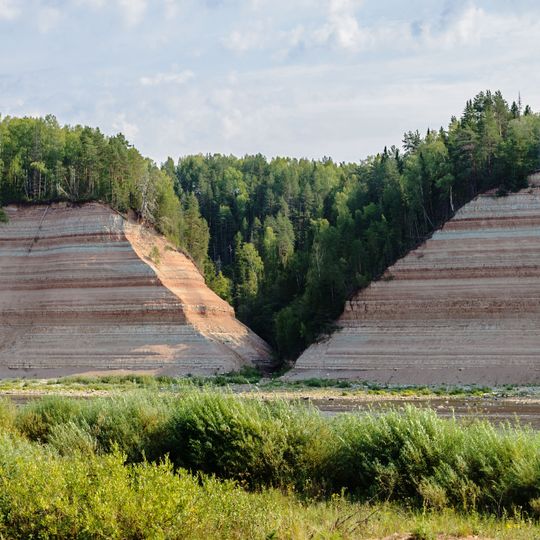
Opoki, Natural monument in Vologda Oblast, Russia
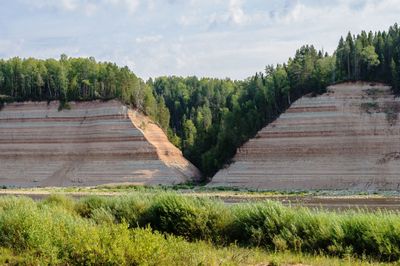
Opoki is a geological exposure on the left bank of the Sukhona River near the village of Porog, where a cliff about 60 metres high and up to 70 degrees steep reveals alternating layers of marl and clay of different colours, dating to the Upper Permian. The ravine cuts through horizontally banded sediment in pale grey, beige, rust red and brown, with trees along the rims.
The site was home to a Gulag labor camp called Opokstroy from 1943 to 1947, where inmates worked on navigation lock construction. This period left a lasting mark on the region's history and memory.
At the tip of the narrow cape formed by the Sukhona's sharp bend stands a memorial cross inscribed "To the innocently suffering", marking the site of the Opokstroy Gulag camp that held 1,100 prisoners between 1943 and 1947. Remains of the dam and the lock chamber built by the inmates lie nearby.
Opoki lies on the Sukhona about 70 km from Veliky Ustyug on the road toward Totma, near the village of Porog. The cliff stands on the left bank at a sharp bend of the river, where the Sukhona forms a narrow, long cape. The 1.5 km rocky Opoki rapid runs past the outcrop, the most dangerous on the Sukhona, so approach the bank with care.
About a kilometre downstream from the rapids, near the village of Bratskoye, a borehole drilled in 1941 during engineering-geological surveys still flows freely. It reaches 192.4 m deep and yields roughly 50 litres per second of slightly brackish water with a mineralisation of 2.6 g/l.
The community of curious travelers
AroundUs brings together thousands of curated places, local tips, and hidden gems, enriched daily by 94,765 contributors worldwide.