Sakhalin Regional Museum, Regional museum in Yuzhno-Sakhalinsk, Russia.
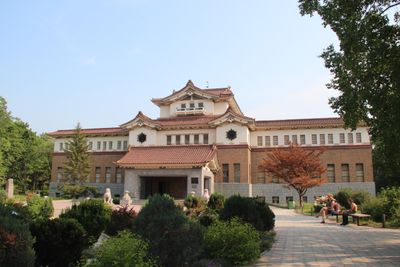
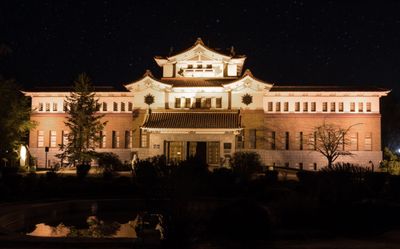
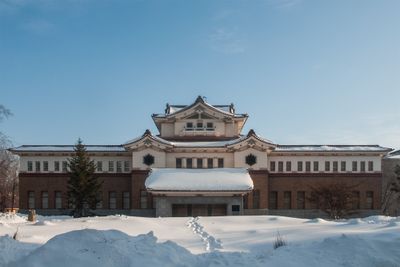
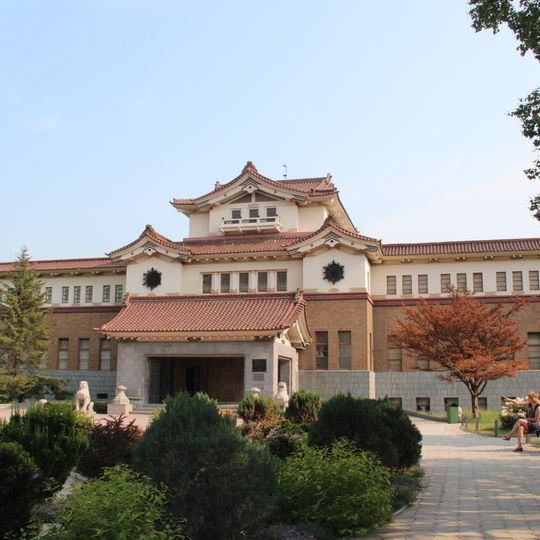
The Sakhalin Regional Museum occupies a 1937 building in the Imperial Crown Style, designed by architect Yoshio Kaizuka. Its cream upper walls and brown brick base rise to a tiered roof of reddish-brown tiles, with a central gable above square windows and matching side gables. A hipped-roof porch shelters the entrance, flanked by two stone lion-dog statues moved from a former shrine.
The museum traces its origin to a museum opened in Alexandrovsk on 6 December 1896 on the order of military governor V. D. Merkazin. In 1937 the Japanese Karafuto administration built the present Toyohara building to the design of architect Yoshio Kaizuka. It was nationalized after the war and reopened as the regional museum on 11 May 1946; Soviet and Japanese staff worked together until the Japanese were repatriated.
The museum displays the traditions of indigenous peoples including the Ainu, Nivkh, and Uilta through objects and old photographs. Visitors can see how these communities lived and what crafts and skills they practiced.
The building stands in the centre of Yuzhno-Sakhalinsk, its entrance facing the street between two stone lion-dog statues moved here from a Shinto shrine. The two-storey halls are visited on foot, with the tank displayed on the grounds outside. Allow time to cross between the natural-history, indigenous-culture and 20th-century sections.
Two granite border markers from the 50th parallel are kept here: "Ten No. 1" from Tonnai in Shikuka district and "Ten No. 3" from Handazawa near Shikuka town. They marked the border between Japanese Karafuto and the Soviet Union; during the Soviet era no material about the Japanese period was displayed, and only after 1991 did these objects go on show.
The community of curious travelers
AroundUs brings together thousands of curated places, local tips, and hidden gems, enriched daily by 94,049 contributors worldwide.