Fort Santo Domingo, Spanish colonial fort in Tamsui, Taiwan
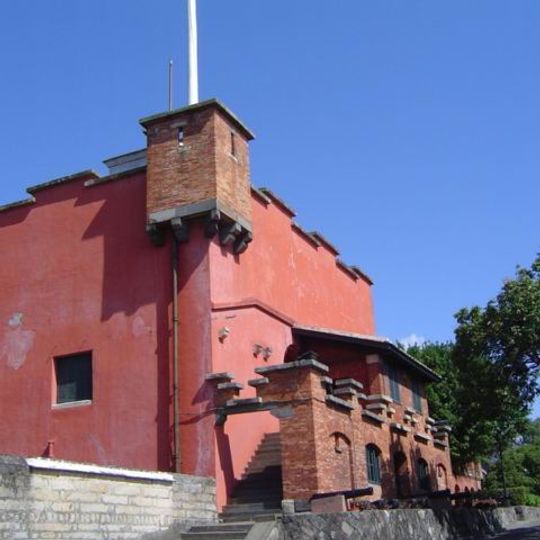
Fort Santo Domingo is a square stone-and-brick fort with 2-metre-thick walls, standing on a hilltop above the Tamsui River. Its red-painted facade rises to a low-pitched roof, with a square red-brick tower on grey stone corbels at the front-left roofline and a stepped brick entrance section on the right.
The Spanish built a wooden fortification in 1628, which the Dutch later rebuilt in stone during 1644 and named Fort Antonio. The British took over the site and used it as a consulate before returning it to Taiwan.
The name Hong Mao Cheng comes from the Han Chinese, who called the Dutch "hong mao" or red-haired. The fort's southwest corner was named Fort Dimen, the northeast Fort Maria and the southeast Fort Sulfur. The former British consulate residence bears a red brick "VR" and "1891" on its facade.
The Red Line of the Taipei Metro runs to Tamsui Station, from where the riverside path takes around 20 minutes on foot. The climb up the hill is moderately steep and offers several viewing points along the way.
The fort's walls are about 2 metres thick, built with stone and brick from Batavia (now Jakarta) on the outer face and local stone, able to resist early cannon fire. The four cannons in front, cast in 1813, were brought in by the British as decoration rather than for defence.
The community of curious travelers
AroundUs brings together thousands of curated places, local tips, and hidden gems, enriched daily by 92,316 contributors worldwide.