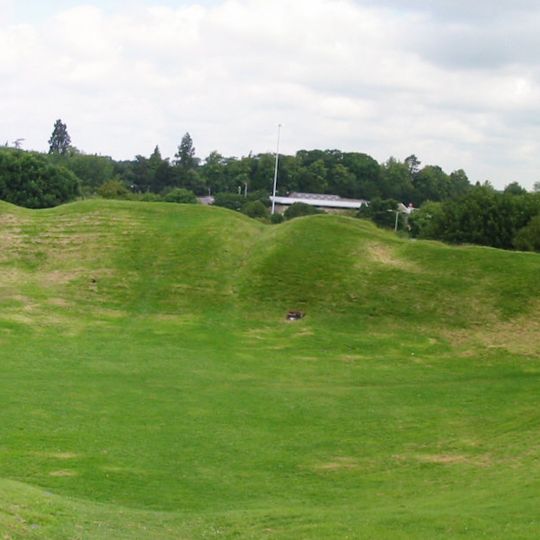
Cirencester Amphitheatre, Roman amphitheatre in Cirencester, England
Cirencester Amphitheatre is a Roman amphitheatre on the western edge of Cirencester, in Gloucestershire, England. It takes the form of two long grassy earthen banks arranged in an oval, enclosing a sunken central area that was once the arena floor.
The amphitheatre was most likely built in the 2nd century, when Corinium Dobunnorum, the Roman name for Cirencester, was one of the largest towns in Roman Britain. After the Romans withdrew, the site was adapted and used for other purposes over the following centuries before it was finally left to nature.
The site is known locally as "The Bull Ring", a nickname that hints at how people imagined its past uses long after the Romans had gone. Visitors today walk along the top of the grassy banks and look down into the hollow below, getting a clear sense of how the space was once shaped around a central floor.
The site is freely accessible throughout the year with no entrance fee. The grassy banks can be slippery after rain, so sturdy footwear makes the walk much more comfortable.
Around the 5th century, as Roman control over Britain faded, the earthworks were converted into a small fortified enclosure with wooden structures built inside the banks. This makes Cirencester Amphitheatre one of very few known examples in Britain where a Roman public building was turned into a defended site in this way.
The community of curious travelers
AroundUs brings together thousands of curated places, local tips, and hidden gems, enriched daily by 90,859 contributors worldwide.