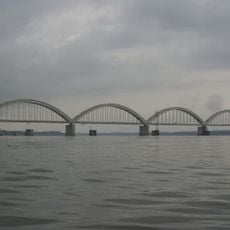
Ivan Dmitrievich Papanin Institute of Biology of Inland Waters, Research facility of the Russian Academy of Sciences in Borok, Russia.
The Institute of Biology of Inland Waters is a research facility of the Russian Academy of Sciences in Borok focused on studying freshwater ecosystems and aquatic organisms. The facility includes laboratories for water analysis, microscopy equipment, and research vessels to conduct field studies on nearby water bodies.
The institute was founded in 1956 and renamed in 1987 to honor Ivan Papanin, who led the first drifting North Pole station in 1937. This naming choice linked the facility to a major figure in polar exploration and freshwater research.
The institute maintains extensive collections of aquatic organisms and conducts regular field expeditions to study Russia's freshwater systems. This work reflects a long tradition of scientific inquiry into the ecosystems that shape the country's landscape.
The facility operates primarily as a research center and may have limited visitor access depending on ongoing projects. Visitors interested in tours or accessing specific areas should inquire in advance about visiting conditions and what is available to see.
The location on the Rybinsk Reservoir allows researchers to track long-term changes in one of Russia's largest artificial lakes directly from the site. This proximity to a major water body makes continuous environmental monitoring possible in a way few other freshwater research centers can match.
The community of curious travelers
AroundUs brings together thousands of curated places, local tips, and hidden gems, enriched daily by 92,857 contributors worldwide.