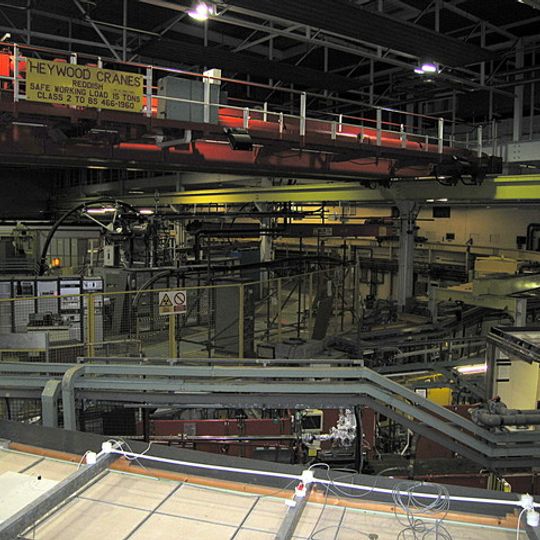
Synchrotron Radiation Source, Research facility in Daresbury, England.
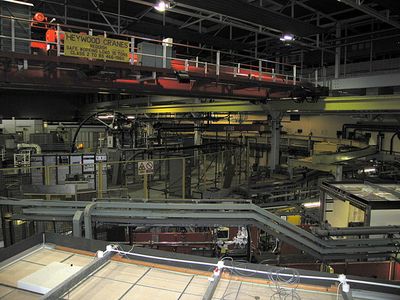
The Synchrotron Radiation Source was a research facility in Daresbury, Cheshire, designed to produce powerful beams of light used in experiments such as protein crystallography and X-ray diffraction. The building housed a large circular storage ring and a set of specialized beamlines, each serving a different type of scientific experiment.
The facility opened in 1981 as Britain's first synchrotron of its kind, marking a new era for experimental science in the country. It closed in 2008, when newer and more powerful facilities elsewhere took over its role.
The site drew researchers from many countries who came to use equipment that was not available elsewhere, turning it into a place of international scientific exchange. Two Nobel Prizes in Chemistry were awarded for work that depended on experiments carried out here.
The site is located in Daresbury, a small village in Cheshire, within easy reach of Manchester. Since it is a former research site that is no longer in active use, it is worth checking in advance whether any public access or guided visits are available.
Some of the experiments carried out here relied on samples that remained stable for only a few hours, requiring teams to plan their work with great precision around limited time slots. The techniques developed to handle these constraints later influenced how similar facilities around the world organized their work.
The community of curious travelers
AroundUs brings together thousands of curated places, local tips, and hidden gems, enriched daily by 60,000 contributors worldwide.