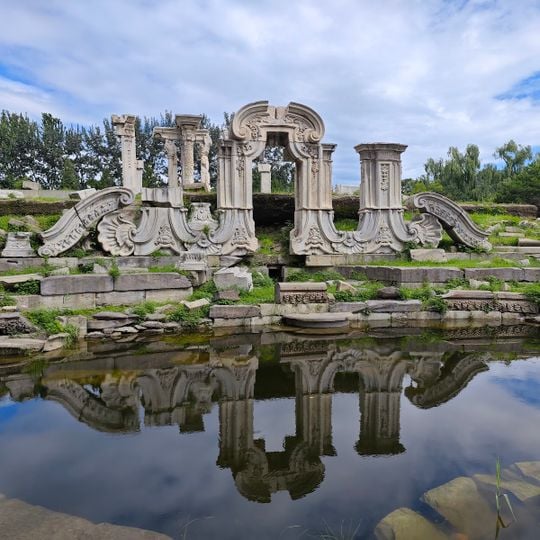
Old Summer Palace, Palace ruins in Qinglongqiao Subdistrict, Beijing, China
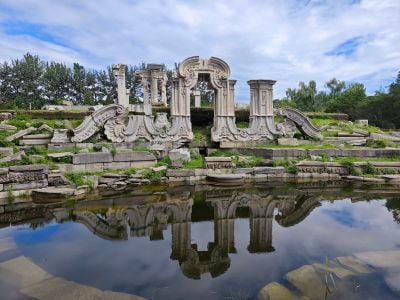
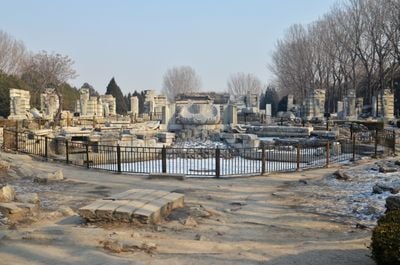
The Old Summer Palace is a ruin site whose visible remains lie mainly in the Western Mansions (Xiyang Lou) area: pale stone fragments, a scalloped stone basin, broken archways with scroll-carved tops, and stepped platforms of overlapping blocks. These European-style structures were designed by the Jesuit Giuseppe Castiglione, with Michel Benoist responsible for the fountains and waterworks.
The complex began in 1709 under Emperor Kangxi as an imperial retreat and was expanded over several generations. British and French troops looted and burned the site during the Second Opium War, leaving only a few stone structures standing.
The site takes its name from the Confucian ideal of perfect brightness and served as a venue for ceremonial gatherings. Visitors today can walk among stone columns and foundations that show how Chinese garden art was combined with European facade elements.
Walking through the ruins requires several hours on foot, as individual sections are spread far apart. Sturdy shoes are advisable because many paths are unpaved and cross uneven terrain.
The stone ruins visible today belong mainly to the Western Mansions, the European-style palaces designed by the Jesuit Giuseppe Castiglione, with Michel Benoist responsible for the fountains. A clock fountain before the Haiyan Tang had twelve zodiac animals that spouted water in turn every two hours and all together at noon.
The community of curious travelers
AroundUs brings together thousands of curated places, local tips, and hidden gems, enriched daily by 93,674 contributors worldwide.