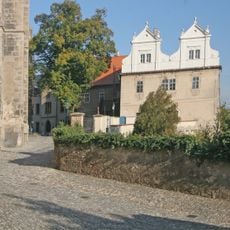
Italian Court, Former royal mint and palace in Kutná Hora, Czech Republic
The Italian Court is a palace with four wings around an irregular square courtyard, founded before 1300 by Wenceslas II as a royal palace with a mint. Six carved fragments of town coats of arms survive above the walled-up portals of the eight mint workshops, and the first-floor Chapel of St Wenceslas and St Ladislaus, consecrated in 1389, has a net vault on a central pillar.
King Wenceslas II established the central mint in 1300, making it the economic center of the kingdom. This led to the creation of the Prague groschen, a currency that became known far beyond the borders.
The name comes from the Italian minting experts invited for Wenceslas II's coinage reform. Around the courtyard stood eight workshops (Smithies) for the royal mining towns, each marked with a carved town coat of arms; six fragments survive, including Jihlava, Most and Písek. The minting chamber was called the Preghaus.
The building is open to the public year-round and receives roughly 25,000 to 47,000 visitors annually. The royal chapel and the audience hall are among the interiors open to visitors, and the cellars hold the exhibit "Unveiling of the mysterious face of Kutná Hora."
The moats that once separated the court from the town survive as cellars in the lower section, and the water they held also protected the castle from fires. Six carved town coats of arms remain from the eight workshops (Smithies) of the royal mining towns that opened onto the courtyard.
The community of curious travelers
AroundUs brings together thousands of curated places, local tips, and hidden gems, enriched daily by 94,356 contributors worldwide.