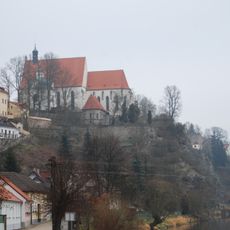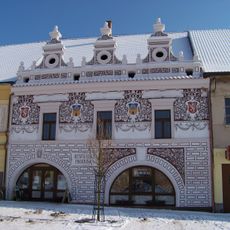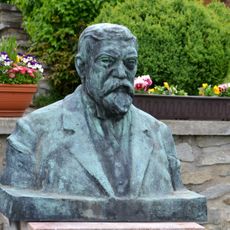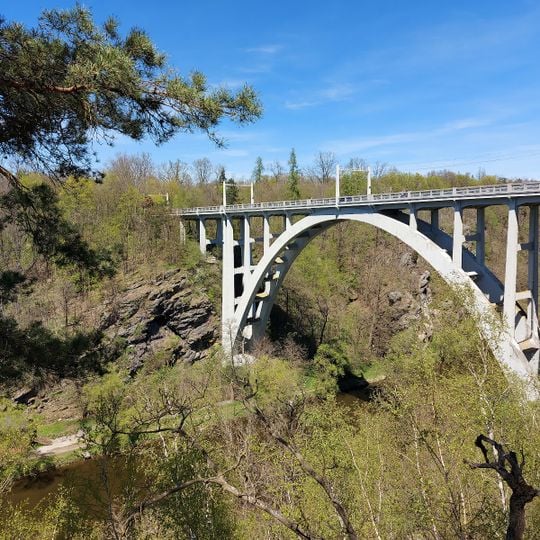
Bechyně Bridge, Railway bridge in Bechyně, Czech Republic.
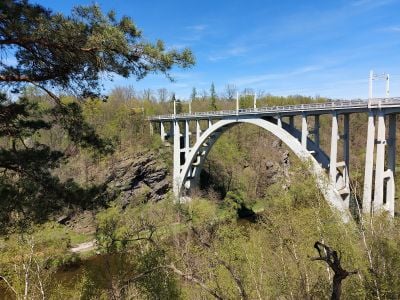
Bechyně Bridge is a reinforced concrete arch bridge over the Lužnice River, carrying both the Tábor–Bechyně railway and road 122. Its main arch spans 90 m with a rise of 38 m, formed by two arched ribs braced together, and the whole structure measures 190.5 m long and 8.9 m wide.
The bridge was designed by Eduard Viktora and built between 1926 and 1928 by the firm Hlava and Dr. Kratochvíl. It replaced a narrow two-metre bridge with a three-tonne limit that forced passengers to descend to Zářečí and climb back up. It opened on 28 October 1928, the tenth anniversary of Czechoslovak independence.
Locals call it the Rainbow (Duha) for its single wide arch over the Lužnice valley. A 1940 five-koruna stamp in the series "Landscapes, Castles and Towns" shows Bechyně with the bridge, engraved by B. Heinz after J. C. Vondra's design.
The railway track runs along the eastern edge of the roadway, nearer the upstream side. When a train passes, a barrier-free crossing safety device halts road traffic heading from Týn nad Vltavou into Bechyně, while the opposite direction continues unaffected. The bridge stands on the eastern edge of Bechyně, where Route 122 meets the Tábor–Bechyně line.
The bridge was built without a single fatality or serious injury among the 400 workers, and the sand for its concrete came from the Lužnice itself, the gravel from the nearby Čermák quarry. Painter Richard Lauda, born in Jistebnice, made a series of etchings of the construction in 1926–1928.
The community of curious travelers
AroundUs brings together thousands of curated places, local tips, and hidden gems, enriched daily by 92,286 contributors worldwide.