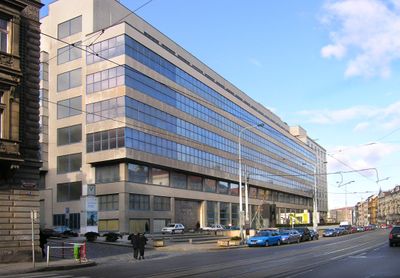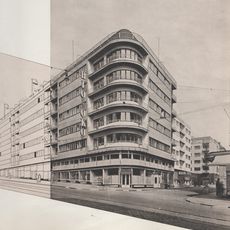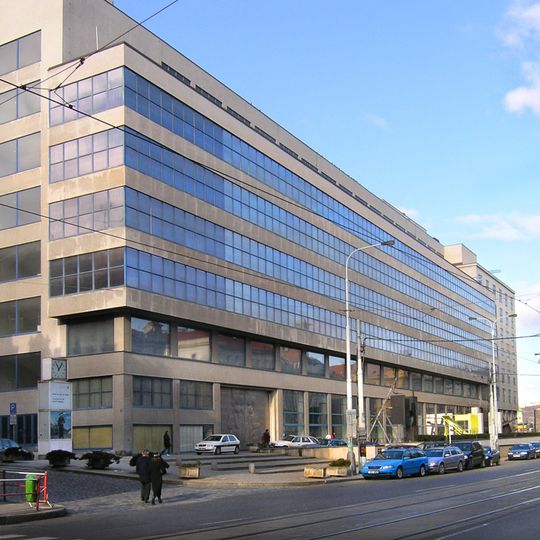
Trade Fair Palace, Functionalist civic building in Prague, Czech Republic.
The Trade Fair Palace is a functionalist building by Josef Fuchs and Oldřich Tyl, built 1925–1928 for the Prague Sample Fairs. It measures 130 m long, 70 m wide and 37 m high, with about 13,500 m² of floor space, and its galleries now hold the National Gallery's art of the 20th and 21st centuries.
The palace was built in 1925–1928 to designs by Josef Fuchs and Oldřich Tyl, winners of an architectural competition, for the Prague Sample Fairs company. With about 13,500 m² of floor space it was then the largest building of its kind in the world. A fire on 14 August 1974 nearly destroyed it; the National Gallery acquired the building in 1976, and full reconstruction was completed in the 1990s.
The building's name comes from the Prague Sample Fairs held here from 1928; after 1945 it housed foreign-trade firms such as Tuzex and Strojimport. Since 1976 it has belonged to the National Gallery, whose permanent display of 20th- and 21st-century art fills three floors with over 2,000 objects, including works by Mucha, Picasso, Monet and Van Gogh. From 2012 to 2016 the ground-floor halls showed Alfons Mucha's Slav Epic cycle.
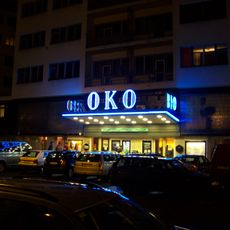
The permanent collection fills the first to fourth floors, with temporary exhibitions on the fifth floor, in the mezzanine and on the ground floor. The Studio Hrdinů theatre occupies the former cinema in the basement, and the Kolektor café is inside the building.
The building's plot on Veletržní street was bought from the Melichar-Umraht company for 6,700,000 Kč after months of bargaining; the sellers had originally asked 29 million Kč. On the site stood Antonín Reissenzahn's defunct foundry and agricultural machinery factory.
The community of curious travelers
AroundUs brings together thousands of curated places, local tips, and hidden gems, enriched daily by 92,286 contributors worldwide.