Křivoklát Castle, Gothic castle in Central Bohemia, Czech Republic
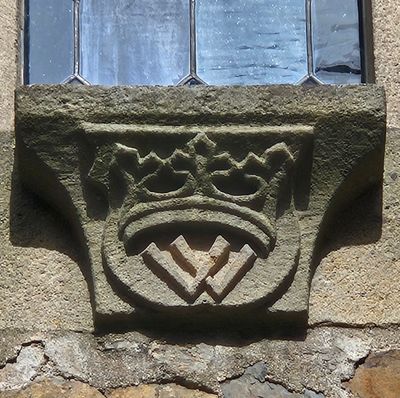
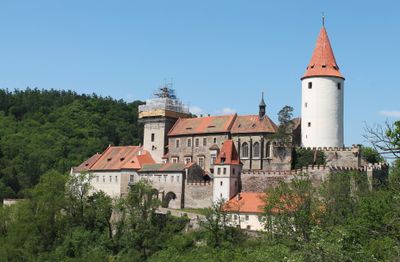
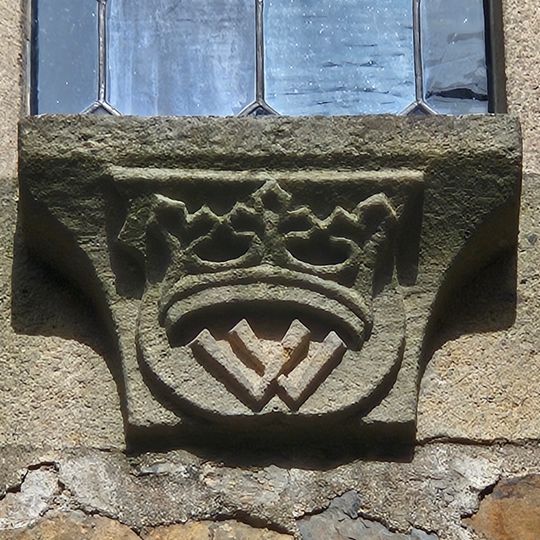
Křivoklát Castle stands on a rocky promontory above the Rakovnický stream, its triangular core divided into a lower and an upper castle. The complex mixes a tall white cylindrical tower with a red conical roof, a long Gothic palace with a chapel of tall pointed windows, and a stone tower under scaffolding. A carved corbel beneath a barred window shows a crown above a W-shaped relief.
The castle was probably founded around 1230 at the turn of the reigns of Přemysl Otakar I and Wenceslaus I, and Otakar II completed a monumental royal castle with a chapel. After a fire in 1826 the Fürstenberg family, owners until 1929, had it reconstructed; it had earlier served as a harsh prison.
The name comes from Krivoplát, an uneven clearing or plateau, recorded as Krivoplat in 1110 and Creoplath in 1222; the -klát ending derives from German Knittel. From the 13th century the castle was also called Hrádek, German Bürgelîn. Today it holds collections of hunting weapons, Gothic paintings and books, and hosts theatrical performances.
The castle stands on a rocky promontory above the Rakovnický stream, with easy access only from the eastern side, so the approach is a walk on sloping ground. The core is divided into a lower and an upper castle linked by gate passages; allow time to move between the courtyards and halls.
One of history's most famous prisoners was the English alchemist Edward Kelley, who tried escaping in 1597 by fashioning a rope from bedsheets and climbing down the walls. His failed attempt remains one of the castle's most talked-about stories among visitors today.
The community of curious travelers
AroundUs brings together thousands of curated places, local tips, and hidden gems, enriched daily by 92,323 contributors worldwide.