Pekárna Cave, Prehistoric cave near Brno, Czech Republic
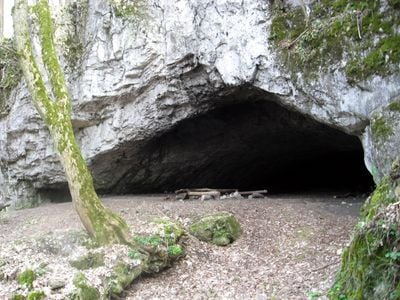
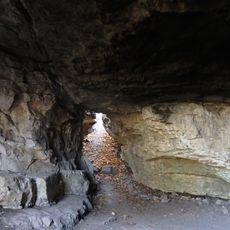
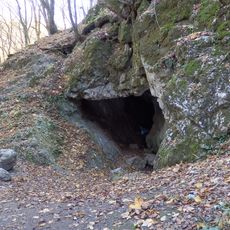
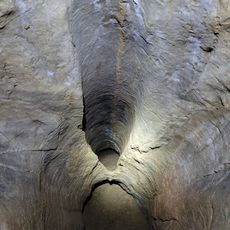
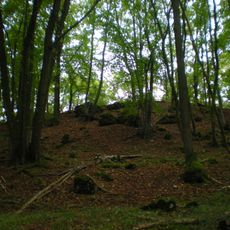
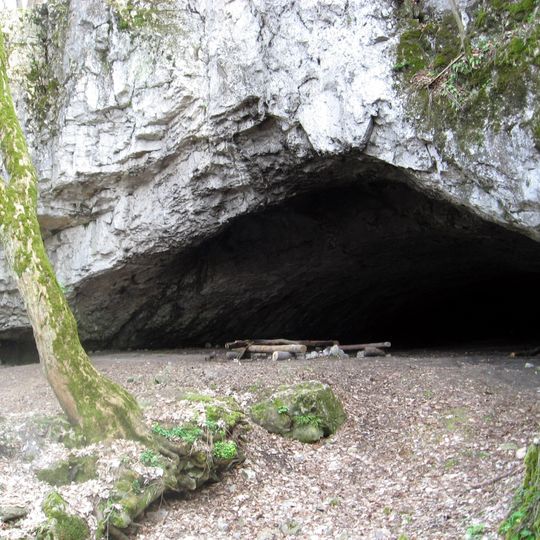
Pekárna Cave is a tunnel-like cave in the Moravian Karst, in the cadastral area of Mokrá u Brna, 1.5 km southeast of Ochoz u Brna. Its portal, up to 6 m high and 23 m wide, opens into the Říčky Valley. Inside is a single 64 m corridor, lit by daylight almost to its end, where a boulder collapse under a chimney blocks the way.
Pekárna was excavated by Jan Knies in 1880, Jindřich Wankel in 1881 and Martin Kříž in 1884–1885; Karel Absolon's work of 1925–1930 made it famous. Finds span the Middle Palaeolithic Micoquien through the Neolithic Linear Pottery culture, Bronze Age and Hallstatt Horákov culture, with the main layers around 11,000 BC belonging to the Magdalenian.
The engravings are on horse ribs, not the cave walls: the "Bison Fight" found in 1927 and "Grazing Horses" in 1963, plus two bears scratched on a pierced antler. They are the earliest known bounded scenes in Palaeolithic art. The finds are kept at the Anthropos Institute in Brno.
This cave sits within a protected natural area and remains accessible year-round in reasonably dry conditions. Visitors should prepare for uneven ground and bring a light source if planning to explore the deeper interior passages.
The cave's best-known finds are two engravings on horse ribs: the "Bison Fight", found in 1927, and "Grazing Horses", found in 1963. They are considered the earliest surviving depiction of a bounded scene rather than isolated animals.
The community of curious travelers
AroundUs brings together thousands of curated places, local tips, and hidden gems, enriched daily by 92,340 contributors worldwide.