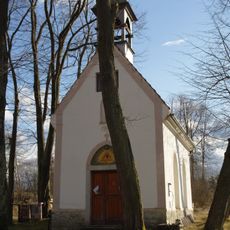
Terčino údolí, National natural monument in Svébohy, Czech Republic
Terčino údolí is a protected valley that combines natural features with human-made structures throughout its landscape. The Stropnice River flows through the area with engineered water channels directing it toward an artificial waterfall, while native forests and planted exotic species cover the slopes.
Count Johann Nepomuk von Buquoy had the English landscape park laid out in 1756 at the wish of his wife Theresia, on the site of a pheasantry founded in 1667; gardener Ignác Fnoika directed the work. The park was later enlarged and embellished with buildings, and in 1949 it was protected as a national natural monument.
The park is named after Countess Theresia von Buquoy, who urged her husband Johann Nepomuk to lay it out in 1756; it was first called Valloncherie. The Blue House, built in 1803, served as her summer residence until 1817, where she held musical evenings. Small monuments decorated with verses praising friendship were scattered through the grounds.
A circular educational trail, rebuilt in 2007, runs about 7 km with 12 stops on nature and history; the Czech source gives 5 km. The park is open to the public, and a reservoir at the valley edge, built in the 1980s, protects it from floods.
The Blue House, built in 1803, is now a ruin: floods in 1915 and 1936 left only the remains of two perimeter walls. Nearby survive cypresses over 15 m tall and a solitary plane tree, planted as exotics around the building.
The community of curious travelers
AroundUs brings together thousands of curated places, local tips, and hidden gems, enriched daily by 94,382 contributors worldwide.