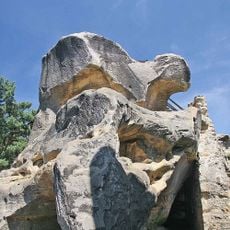
Klokočské skály, Nature reserve in Bohemian Paradise, Czech Republic
Klokočské skály is a sandstone rock area above the village of Klokočí, about four kilometres north-east of Turnov. Its main ridge is roughly 60 metres high and 1600 metres long, split into a few towers such as Džbán and Radnice; the northern part is called Betlémské skály.
The first settlement of the rocks dates to the Late Stone Age, 6th–3rd millennium BCE, and Bronze Age pottery shards were found in Postojna and Jislova caves. Rotštejn castle, built in the mid-13th century by Jaroslav and Havel of Markvartice, was burned by the Hussites in 1426 and abandoned. The reserve was declared on 13 June 1985, and the area joined the Český ráj protected landscape in 2002.
The rock towers carry names such as Džbán (the Jug) and Radnice (the Town Hall), and the rounded formations are called Elephants. The cave Postojna is also known as Amerika. The ruins of Rotštejn, a castle built largely of wood in the 13th century, stand in the southern part of the area.
The yellow-marked trail runs through the reserve and passes the Postojna cave, the only accessible cave in the whole of Český ráj. The rock plateau at the top is dry, while the ravines below stay damp, so the paths differ in character. The ruins of Rotštejn stand in the southeastern part of the rocks.
The rock face is studded with spherical sandstone concretions up to a metre across; these were the least resistant spots in the stone, so weathering hollowed them out and left the cavities and small caves seen today. The 3 km² area holds all the basic pseudokarst cave types, 300 in total.
The community of curious travelers
AroundUs brings together thousands of curated places, local tips, and hidden gems, enriched daily by 92,143 contributors worldwide.