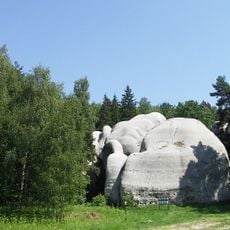
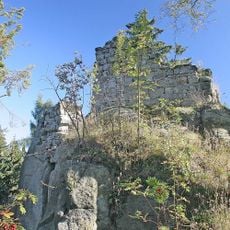
Vraní skály, Rock formation in Hrádek nad Nisou, Czech Republic.
Vraní skály is a group of seven freestanding sandstone towers in the Lusatian Mountains above the Krásný důl valley near Hrádek nad Nisou, at about 500 metres above sea level. The best-known tower is Fellerova věž; others include the two Šachtové věže, Krkavec, Krkavcová, Krkavčí hnízdo, Hruška and Malá hruška. A deep cleft separates the northern and southern parts.
The first recorded ascent of the main tower was made on 17 June 1894 by Zittau professor Theodor Feller with Adolf Gahler and Ferdinand Siegmund, using a rope ladder rather than climbing techniques; the tower has borne Feller's name since. The first true roped free climb followed on 21 May 1904, by Karl Kirchhof and Franz Salomon.
The rocks bear two names: Rabensteine in German and Vraní skály in Czech, reflecting the multilingual heritage of this border region. Both terms have been used for generations by communities living nearby.
The rocks stand about 500 m above sea level above the Krásný důl valley, roughly 1 km west of Horní Sedlo and about 1 km from both Popova skála and Horní skály. Access is on foot; the towers are climbing terrain with marked routes from grade IV to VIII UIAA, so non-climbers should stay on the paths below.
The cleft between the northern and southern parts of the group is not a weathering feature: volcanic activity heated the sandstone on both inner faces, hardening it. The rock is Cenomanian sandstone of the Upper Cretaceous, with conglomerate layers and iron incrustations, and the hardened walls made the towers a climbing target from the late 19th century.
The community of curious travelers
AroundUs brings together thousands of curated places, local tips, and hidden gems, enriched daily by 92,145 contributors worldwide.