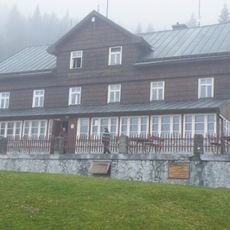
Albeřická jeskyně, Underground cave system in Horní Maršov, Czech Republic.
Albeřická jeskyně is a limestone cave network with multiple levels containing corridors, chambers, and passages of varying sizes. It holds the largest subterranean lake in the Czech Republic, which occupies several sections throughout the system.
The cave was discovered in 1887 during limestone quarrying operations but remained largely unexplored for decades. Systematic research began in 1968 and gradually revealed the full extent of the underground network.
The cave is a winter roost for bats, most commonly the Daubenton's bat, greater mouse-eared bat and lesser horseshoe bat. Because the cave itself is closed to the public, the roost is not something visitors can watch; the bats are recorded by speleologists surveying the cave.
The cave itself is closed to the public; the entrance lies in Bischof's Quarry, which the red-marked Cesta bratří Čapků trail passes. The cave can only be entered by speleologists, and its lower levels are flooded to depths of up to 20 metres.
The cave is inaccessible to the public; the red-marked Cesta bratří Čapků trail passes only by Bischofův lom, the quarry holding the entrance. Exploration since 1968 has documented four levels, and the flooded fourth level's passages continue toward Poland.
The community of curious travelers
AroundUs brings together thousands of curated places, local tips, and hidden gems, enriched daily by 94,254 contributors worldwide.