Karlův Hrádek, Gothic castle ruin in Purkarec, Czech Republic
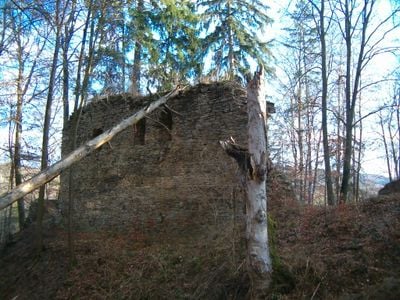
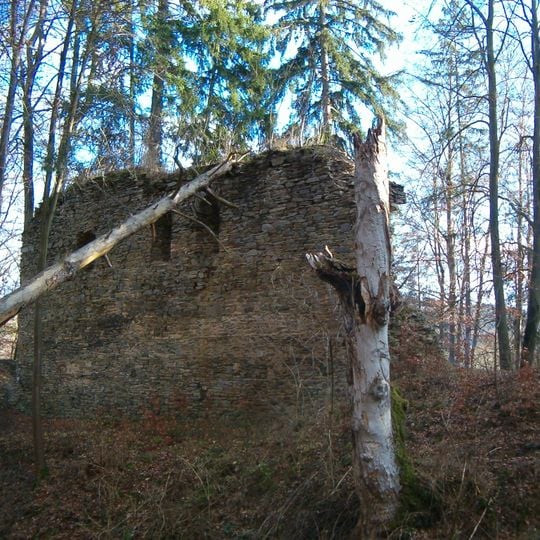
Karlův Hrádek is a ruined Gothic castle whose core has a polygonal plan enclosed by palace wings, surrounded on all sides by a massive rampart and ditch. A gate with seats in its passage opened from the north, and the largest room was a chapel in the eastern corner, vaulted with two bays of cross vaults and lit by tall pointed windows. The surviving curving wall of rough brown, gray and tan stones, pierced by two rectangular window openings, stands above dry leaf litter and low vegetation.
First documented in 1357, when Charles IV disputed the Rožmberk family over the castle he had named Karlshaus. Archaeology in 2019 and 2021 pushed its origin back to the second half of the 13th century, likely under Přemysl Otakar II. Its only recorded burgrave was Petr z Nasavrk in 1364; after 1370 written mentions cease and the castle was abandoned.
The name Karlshaus, recorded in 1357, links the ruin to Charles IV, who planned a new estate here separate from Hluboká, with a small town and parish church. The town vanished with the castle; some authors identify it with today's Purkarec.
The freely accessible ruin lies about two kilometres from Purkarec, reached on foot by the red-marked E10 trail from Purkarec to Hluboká nad Vltavou. Cyclists can take a short detour from the nearby cycle path carrying routes 7, 1079 and EV7.
Archaeological excavations in September 2019 by University of South Bohemia archaeologists found traces of a much older, probably prehistoric settlement beneath the castle, including wall remnants, pottery fragments, metal, bones and burnt wood. The castle itself was long attributed to Charles IV, but research in 2019 and 2021 dated its foundation to the second half of the 13th century, likely under Přemysl Otakar II.
The community of curious travelers
AroundUs brings together thousands of curated places, local tips, and hidden gems, enriched daily by 93,782 contributors worldwide.